Key ideas
- •Israel has successfully tested an interceptor that could represent the West's first dedicated defence against manoeuvring hypersonic missile threats.
- •The next-generation system combines AI-driven guidance, real-time trajectory updates, and a shoot-look-shoot capability to engage targets that change course in flight.
- •Its development is being shaped by three years of real combat data from intercepting Iranian and Yemeni ballistic missiles, rather than simulations alone.
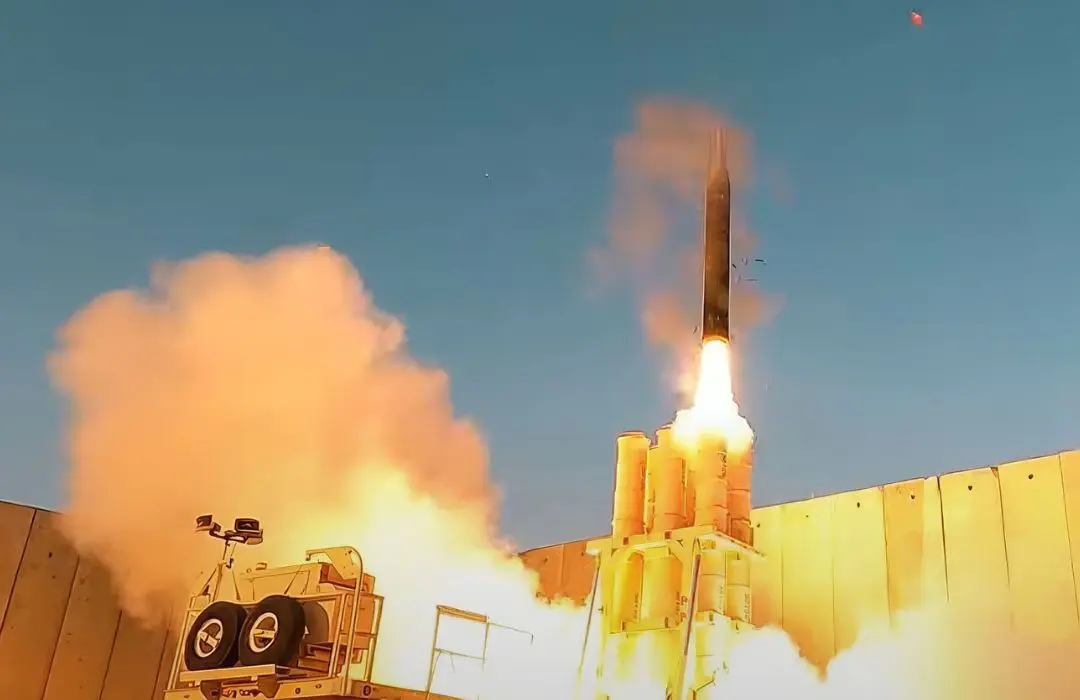
On Wednesday evening, an interceptor trail cut across the sky over Ashdod, a district in Israel which lies on the Mediterranean coast 32 kilometres south of Tel Aviv. Footage from the town showed the trail over the southern coastal plain, and it alarmed people on the beach. The Defence Ministry only confirmed a test had taken place after reports of the sighting were already circulating.
When confirmation came, it provided information about the “successful launch test of the Arrow weapon system.” The Ministry said the trial was part of a multi-year development programme evaluating new capabilities against future missile threats. It disclosed no further detail, which is typical for an Arrow missile test. But the ministry also said the test was a part of the “upgrade of the system,” which hints towards a new hypersonic interceptor, possibly Arrow 4, might have been tested.
Israel’s Arrow system
Arrow forms the top tier of a defence network that also includes Iron Dome, David’s Sling and Iron Beam, each covering threats at a different range and altitude. Arrow’s job is the hardest of the four, reaching the highest and furthest, using long-range radar and a dedicated fire control system to guide interceptors into targets most other systems could never reach.
Arrow 2 handles the upper endo-atmospheric layer, intercepting inside the atmosphere as a missile begins its final descent. Arrow 3 goes further, hitting targets exo-atmospherically, above the 100 kilometre (62 mile) line usually treated as the edge of space. The Green Pine and Super Green Pine radars do the detection and tracking. IAI’s Systems, Missiles and Space Group builds the interceptor, and Elbit Systems runs fire control.
When a ballistic missile’s rocket engine stops working, it becomes easier to predict its path. It follows a curved trajectory that radar can track early on. It helps fire control systems determine where the missile will land before interceptors are even launched. Arrow 3’s kill vehicle uses this predictability to target the missile accurately, striking it at a location that is already known.
However, threats that can change direction affect missile defence calculations. A hypersonic glide vehicle does not just fall like a regular missile; it flattens its path and uses aerodynamic lift to glide in the upper atmosphere, adjusting its course along the way. Iran’s Fattah-1, which launches a manoeuvrable re-entry vehicle from a booster in the same altitude range as the Arrow 3, has already tested this vulnerability in the current conflict.
It is not clear how much it has reduced Arrow 3’s chances of intercepting the target. An interceptor that is aimed at a fixed location cannot adjust if the target changes direction.
The Arrow 4
IAI began flight tests of Arrow 4 in mid-February 2026, an interceptor meant to eventually take over Arrow 2’s role while extending coverage against manoeuvring targets Arrow 3 was never built to catch. It adds aerodynamic control surfaces that let it manoeuvre during flight, guided by an AI system that recalculates the intercept point in real time as new tracking data comes in, rather than committing to one solution at launch.
Arrow 4 also runs on a shoot-look-shoot doctrine, firing one interceptor, assessing in real time whether it will hit, and launching a second before the first arrives if it looks set to miss. The system is built to operate above Mach 10 in both the endo- and exo-atmospheric envelope, roughly 3.4 kilometres (2.1 miles) every second. Arrow 3 is a very precise answer to a question that does not change after it is asked. Arrow 4 is built to keep answering the same question as the target keeps changing it.
The Arrow 3 system first successfully intercepted a Houthi Ghadr-110 missile on November 9, 2023, while it was heading towards Eilat. It was tested on a larger scale on April 13 and 14, 2024, when it shot down most of the approximately 120 ballistic missiles that Iran launched at Israel during Operation True Promise.
However, a large attack from Iran in October 2024 revealed the system’s weaknesses, and Arrow 3 has failed at least one publicly reported interception of a Houthi missile. During the twelve-day Operation Rising Lion in June 2025, the Defence Ministry reported that Arrow 2 and Arrow 3 together had an accuracy rate of 86 per cent.
On February 28, 2026, the US and Israel launched a military operation against Iran. The US called it Operation Epic Fury, and Israel named it Roaring Lion. The campaign began with airstrikes that killed Iran’s supreme leader, which led to forty days of intense fighting and ended in a ceasefire on April 8. In June, there were plans for talks to resolve the conflict, but they fell apart after Iran attacked ships in the Strait of Hormuz.
Arrow featured heavily once more during that campaign, alongside the rest of the missile defence array. Low-level exchanges between Iran and the US-Israel coalition have continued since, short of February’s scale but not at zero.
That is close to three years of a major state actor firing real ballistic and manoeuvring threats at a system in continuous operational use. No other Western missile defence programme has been able to accumulate that outside a testing range.
The factory problem
In April 2026, a statement from the Ministry highlighted that Arrow’s future depends on both industrial and engineering factors. They linked ongoing effectiveness to the need for more production capacity and a new procurement phase. Building interceptors like these takes time, and Israel used up its stock more quickly than planned for peacetime.
Tomer manufactures solid rocket motors in Israel and is responsible for propulsion. Rafael Advanced Defense Systems and the American company STARK Aerospace are key subcontractors for the interceptor line, not just minor suppliers. To bring Arrow 4 into production alongside Arrow 2 and 3 while increasing output means that all these lines must run more intensively at the same time. It is especially challenging because it relies on a small industrial base that is already operating under wartime conditions.
Germany is a strong example of a successful investment in a defence system. In December 2025, the Bundestag approved a $3.1 billion expansion of the Arrow 3 contract. This adds to an initial $3.5 billion deal, making the total about $6.5 billion. This is the largest defence export deal in Israeli history. Germany’s decision was based on three years of combat data that no other system could provide, not on marketing.
The Ministry said it will provide more details about the test “in the coming hours.” As of now, there are no updates. It is not confirmed whether this launch involved Arrow 4. However, the interceptor designed to address the issue Arrow 3 could not has been in use for six months. The country’s top customer recently paid a record amount for the previous system, and the ministry conducting this test has spent three years figuring out what to keep quiet.