Key ideas
- •IWI's ARBEL turns a standard rifle into a counter-drone weapon by using a computer-controlled trigger that improves hit probability without changing the rifle or its ammunition.
- •A dedicated anti-drone algorithm optimises the weapon's firing cadence, helping soldiers engage fast-moving FPV and fibre-optic drones at ranges of up to 500 metres.
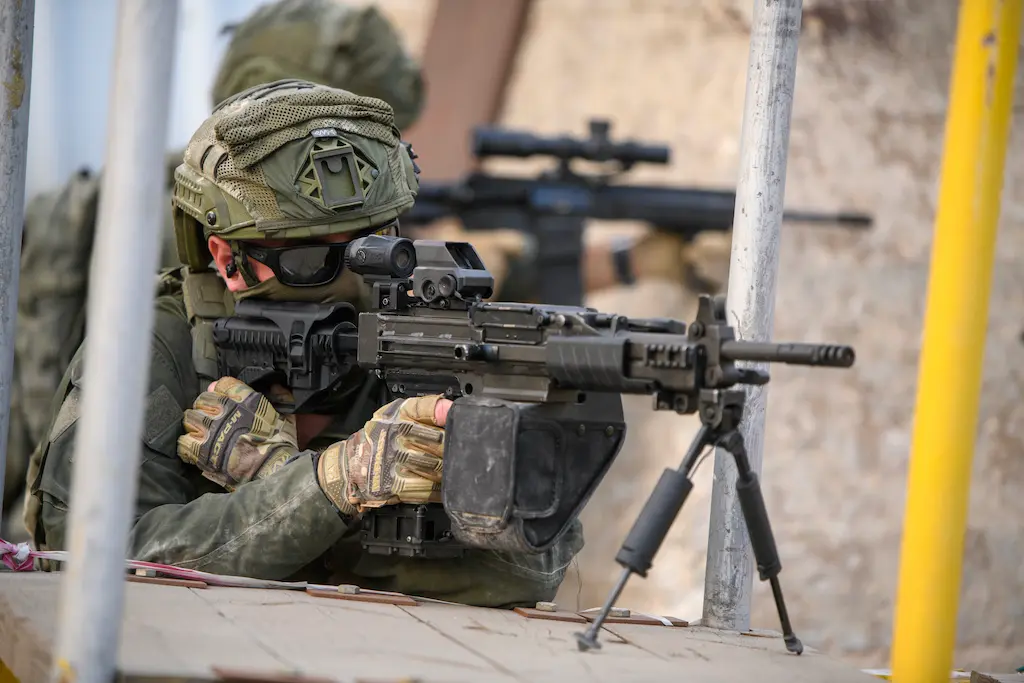
- •Unlike specialist counter-drone systems, ARBEL distributes anti-drone capability across an entire infantry force by integrating directly into soldiers' existing rifles and machine guns.
The counter-drone issue includes an aspect that many defence systems often overlook. Detection systems are effective at identifying drones, but electronic warfare can disrupt their control links. Specialised interceptors, such as missiles, lasers, nets, and shotgun systems, are designed to eliminate any drones that manage to get through. The multi-layered approach works well until it encounters a gap in defences.
Fibre optic drones do not use radio signals, which means they cannot be jammed. Instead, these drones communicate through a glass cable that trails behind them as they fly, making it impossible for electronic warfare tools to intercept their signals. One layer of the usual counter-drone defences is removed, and what remains is the need to shoot down the drone before it physically reaches its target.
“Today we see the rise of fibre-optic-operated drones,” Semion Dukhan, Director of Israel Weapon Industries (IWI) and the SK Group, told Tecrow. “It means that there are no radio frequencies used even to operate these drones. It makes it much harder to hijack or to eliminate the threats using electronic means, which leaves us with the last line of defence, the kinetic hard kill solutions.”
Kinetic solutions have their own issues. Most of them need a special weapon system that is different from the rifle the soldier is already using. Shotgun shells can effectively target drones at about fifty to one hundred meters. Net launchers require their own platform. If a soldier sees an incoming first-person view (FPV) drone while engaging a human target, he has to stop using their current weapon, get a separate system, aim at the drone, and fire, all within a few seconds before the drone gets closer. In many real situations, the process takes longer than the time they have.
IWI created a new solution, which it calls the ARBEL computerised weapon system. Instead of a special weapon for stopping drones, the company has developed a computer that fits inside the rifle a soldier already uses. After detecting a drone, the soldier only needs to aim and keep pulling the trigger; the weapon releases an “accurate and lethal shot” using ARBEL.
What is ARBEL
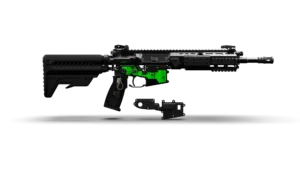
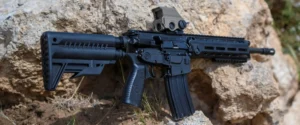
ARBEL is a computer built into the trigger mechanism. The integration changes how a soldier interacts with the trigger and when the bullet exits the barrel. In the AR-15 rifle setup, which many military forces around the world use, the whole lower receiver is swapped out using just two pins. The standard lower comes off, and the ARBEL lower is attached. Inside the handgrip, there are sensors, accelerometers, and gyroscopes that the computer uses to track how the weapon moves.
The battery is located in the buffer tube at the back of the stock. The upper receiver remains unchanged. The barrel, optics, magazine, and ammunition are all the same. An operator who has never used ARBEL can pick up a rifle with this system and fire it in standard semi-automatic mode without any training, as it works just like the weapon they are already familiar with.
“If he [the soldier] doesn’t want to interact with the system because he doesn’t want to use ARBEL at the moment, he doesn’t have to,” Dukhan told Tecrow. “He can still use a semi-automatic regime, or he can just release the trigger when he doesn’t want the system to shoot for him. So it’s everything he knew before, only with an addition of this enhancement.”
For the IWI NEGEV light machine gun, the integration point is different. The handgrip is replaced rather than the lower receiver, accommodating the NEGEV’s different architecture. The grip becomes visibly larger, Dukhan acknowledged; he compared it to a Makita power tool, but the concept is identical. The computer lives where the operator’s hand closes around the weapon, sensing every movement from that central contact point, and controlling what happens at the trigger.
The battery adds approximately 250 grams. It lasts sixty hours of operation in ARBEL mode, enough for several days of active combat, enough for weeks of standard deployment. When it runs out, a replacement takes seconds to swap in the field. And if it runs out with no replacement available, the weapon continues to function as a standard rifle.
The two algorithms
Describing ARBEL as one system overlooks an important fact. It actually runs two different algorithms. Each algorithm addresses a separate problem related to why trained soldiers miss the targets they aim at.
The standard algorithm helps solve the accuracy issues that arise in regular infantry fights. A soldier under stress does not perform as well as they do on a practice range. Their heartbeat speeds up, breathing becomes rapid, fatigue builds up, and muscle shakes occur. These reactions are normal responses to combat and affect every soldier, no matter how much they have trained.
As a result, bullets go where the barrel pointed for just a moment, not where it was aimed when the soldier decided to shoot. The time between decision and action includes movement that the bullet records accurately. ARBEL’s standard algorithm helps bridge the gap in shooting accuracy.
The operator pulls and holds the trigger. The system measures the speed, force, and smoothness of the pull to understand what the operator wants. A slow and careful pull shows a stable situation where accuracy is essential. A fast pull signals stress or urgency, meaning speed is more important than accuracy.
Once the system understands the operator’s intent, it continuously monitors the barrel movement through grip sensors. Accelerometers and gyroscopes create a real-time view of shaking, recoil, and tracking movement. The system waits until the barrel is stable enough, what Dukhan calls “stable enough,” before releasing the round. The round is not released when the finger is at the firing point, but when the barrel is in the right position.
“The system takes all of that into consideration,” Dukhan told Tecrow. “When you are stable enough, and enough is exactly the brains of the system of what is called enough. But as an operator, it is very natural for you to see that. When you’re stable enough, the next bullet will go out.”
The result, according to IWI’s testing and the brochure, is a two- to three-times increase in hit probability under stress conditions. The first shot is always controlled directly by the operator. ARBEL mode governs subsequent rounds while the trigger remains pulled, and the operator can override it at any moment simply by releasing and re-engaging.
The anti-drone algorithm is a different engineering solution to a different physics problem. Drones do not require the stability-detection approach because the engagement geometry is different. A human target is large, and its position changes slowly relative to the engagement window.
A small tactical drone is fast; its flight path is unpredictable, and the window of effective engagement is measured in fractions of a second. Waiting for a stability moment, as the standard algorithm does, is the wrong approach for a target that will have moved significantly in the time the computer waits.
The anti-drone algorithm controls how quickly the gun fires. It finds the best timing for firing successive rounds to hit drone targets effectively. IWI ran thousands of tests to find the right firing rate that allows operators to keep the gun steady while aiming at the drone.
If the gun fires too quickly, the recoil will move the barrel off target before the next shot. If it fires too slowly, the drone will escape before enough shots hit it. The algorithm optimises the firing rate to make it feel like fully automatic fire to the operator, but it improves on that with better timing.

“It’s fast enough for you to shoot, it’s slow enough for you to control the weapon,” Dukhan explained. “And this is achievable because we are mechanically interfering, electronically interfering with the trigger system. So it’s basically, from a technical point of view, it’s a very fast semi-automatic, but you, as an operator, it’s like shooting full automatic.”
Critically, ARBEL does not aim at the drone. The system has no sensor for detecting or tracking an airborne target. It has no idea what the operator is pointing the rifle at. The operator does all the acquisition and aiming.
ARBEL removes one specific source of failure, the variability in trigger timing that causes rounds to miss even when the muzzle is in the right place, and optimises the cadence of fire once the operator has put the weapon on the target. It solves the problem it was designed to solve and makes no claim on the problems it was not designed to solve.
“The system does not know where the drone is,” Dukhan said. “The system is only integrated into the weapon. It does not give you the solution for detection. It does not give you the solution for proper aiming at the target. It only increases the probability for you to hit by eliminating or by controlling the fire cadence and the trigger work of the operator.”
Effective range in the anti-drone configuration runs to approximately 450 to 500 metres in daytime conditions using standard 5.56mm ammunition. At night the practical range drops to approximately 250 metres, a constraint of the operator’s ability to visually acquire and maintain a small fast-moving target at distance rather than any limitation in the system itself.
IWI has successfully intercepted drones during the day with two operators firing at the same time. The method increases the chances that the shots will hit the drone’s flight path.
The force structure
The specific capability of ARBEL against drones is not, according to Dukhan, the most important thing about it as a counter-drone solution. The most important thing is what it does to the distribution of that capability across a military force.
Every existing kinetic counter-drone solution requires either a specialist or a dedicated weapon system or both. A shotgun team capable of engaging drones at range is a specific asset. An anti-drone laser operator is a specific person. An electronic warfare team is a specific element.
When a drone attacks a unit, the unit’s ability to respond kinetically depends on whether the right asset is within the right distance at that moment. In distributed infantry operations, in urban terrain, in the dynamic positioning of modern combat, that dependency creates gaps.
“Because almost everyone is now equipped with the system, anyone can be the one interacting or intercepting the drones,” Dukhan said. “You’re not reliant on any specific person or specific equipment that needs to be next to you in case that you are being attacked now by this drone, you can do that yourself. That’s incorporated in your main weapon.”
A force equipped entirely with ARBEL-enabled rifles has no gap of this kind. Every soldier is capable of the anti-drone engagement without changing weapons, without retrieving additional equipment, without waiting for a specialist.
A soldier in contact with a human threat who spots an incoming FPV can engage the drone and return to the human threat without touching anything other than a mode selector. The engagement is possible because the capability is already in the soldier’s hands.
When more operators use the same drone at the same time, the chances of intercept increase. The cost of adding this capability is very low once ARBEL is included. It doesn’t require a new type of ammunition, new weapons, or extra training beyond getting familiar with the ARBEL trigger mode.
“You can interact with one threat and then interact with the drone and back to the main threat. You don’t need to do anything differently with your equipment,” Dukhan said. “And lastly, because we can equip a bigger portion of the force, more people at a given time can be the ones intercepting, and those who increase the probability of hitting the drone quickly and reliably because you have more than one person interacting with the threat.”
The installation on rifle
One of ARBEL’s engineering decisions that impacts procurement is the choice to place all system components within the existing weapon geometry instead of adding external hardware. The decision was intentional, according to Dukhan, and aligns with a philosophy of minimising interference with the operator’s current relationship with the weapon.
For existing AR-15 rifles in service, the upgrade can be achieved by replacing the lower receiver. The process does not require a gunsmith, armoury rework, or specialised tools. To complete the upgrade, remove two pins to detach the standard lower receiver, install the ARBEL lower, reinsert the pins, and the weapon will be ready to use.
All current training procedures remain valid, and existing maintenance procedures for the upper receiver stay the same. The only new procedure is the ARBEL trigger mode, which necessitates some familiarisation firing instead of a full training course.
“In terms of training, it’s reduced to a minimum because the operator already knows how to operate the weapon,” Dukhan said. “He only needs a few rounds or a few sessions in the range to get used to pulling the trigger and keeping it pulled to interact with the system.”
The battery replacement is designed to be practical for use in the field, not just in storage. A spare battery weighs 250 grams and can fit in a standard kit without adding much weight. The operator can replace it in seconds, without any tools, and if he doesn’t have a spare and the battery runs out, the rifle will still work normally in semi-automatic mode but without ARBEL capability. The design prevents the system from creating new dependencies where none existed before.
The NEGEV integration adds about 900 grams at the grip, making it heavier than the AR-15 lower receiver swap, which adds under 400 grams. Dukhan recognised that the grip looks different from the standard one. However, he pointed out that the way it operates is the same, and the extra weight is manageable for the NEGEV’s frame and the operator’s handling.
Procurement and adoption
IWI says that ARBEL is currently used or being implemented in 25 countries. Dukhan told Tecrow that 10 to 15 of these countries are in Europe, a number that shows that the demand for small-arms drone interdiction is highest in this region.
The influence of the ongoing war in Ukraine on European military procurement is well documented, and the FPV drone as a ubiquitous infantry threat is a lesson European defence ministries drew from Ukrainian battlefield reports before their own procurement offices moved.
It’s important to clarify what the 25 countries represent. The number includes countries at different stages. Some are already using the equipment, while others are still evaluating or implementing it. Out of these, ten to fifteen are in Europe, which limits the number of countries actively using the equipment to some extent. However, the wide interest from national defence agencies over the past 25 years shows where there are gaps in capabilities according to current threat assessments.
In addition to ARBEL, IWI has a range of counter-drone solutions. The company also offers specialised shotgun options through its US subsidiary. One example is the TS-12, which has a high capacity and is effective for counter-drone operations where a dedicated operator uses specific ammunition. The ARBEL and the shotgun represent different approaches to countering drones. The shotgun focuses on a specialist tool, while the ARBEL distributes capabilities across the entire force.
“I would say that ARBEL is now our leading solution against drones,” Dukhan said, “but we of course still support the more conventional or more regular solutions, like either regular rifles or machine guns or even shotguns that we do sell from IWI US.”
Software and the upgradeable weapon
One important feature of ARBEL that often gets overlooked is its ability to receive software updates over the air. Since ARBEL is a computer that runs algorithms, we can update the software in deployed systems without needing to change any hardware.
Dukhan clearly stated IWI’s development plan. The company is currently focused on improving existing algorithms based on feedback from systems already in use. The architecture supporting this improvement also allows for new capabilities. These include different firing modes, varied responses to threats, and the ability to set rules or permissions for firing conditions. The updates can be applied to weapons that are already in the field.
“It’s very easy for us even to update and upgrade existing systems that are already deployed,” he said. “It’s a matter of seconds to upgrade the software, and you’re good to go with a new solution.”
When procurement teams buy an ARBEL today, they are not just getting a fixed tool. They are getting a system that can grow and adapt to changing threats without needing a new purchase or hardware upgrade. For instance, the rifle a soldier uses in 2026 can operate on a different ARBEL software version in 2028, updated with two more years of experience in dealing with drone threats that will also have changed during that time.
Dukhan ended the interview with a prediction instead of a sales pitch. The ARBEL drone system is meant to tackle threats from various types of drones, such as tactical FPV drones, surveillance drones, and those that drop bombs. These threats will increase in the coming years, not just in military settings but also in organised crime, terrorism, and cross-border smuggling. The danger is not just a temporary issue tied to current conflicts. It will be a constant part of the security landscape for any military, law enforcement agency, or border protection service working in open areas.
The solution that scales most practically against a threat that distributed itself across every front and every adversary does not require specialist training, specialist equipment, or specialist positioning. It lives inside the standard weapon and activates when the standard weapon points at the target.
“The threat is there; it will only increase,” Dukhan said, “and you need something easy to implement and very efficient in the field. And this is exactly what ARBEL is.”