Key ideas
- •IAI's ELLYON combines electronic attack and intelligence gathering on a single aircraft, allowing it to detect threats and jam them from the same platform.
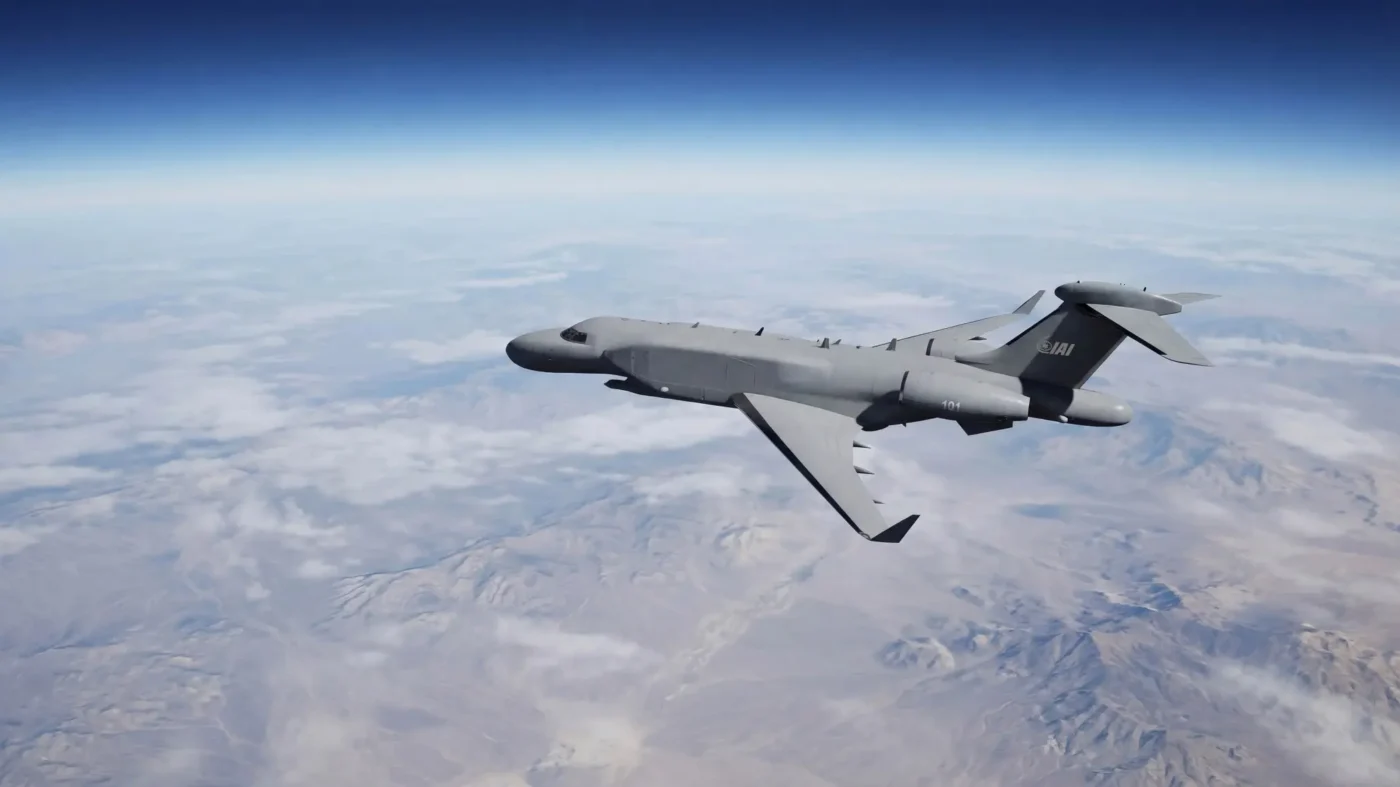
- •The platform integrates SIGINT, electronic attack, SAR/GMTI, electro-optical sensors and satellite communications on a Bombardier Global 6500, while remaining adaptable to other business jets.
- •ELLYON is designed as a stand-off system, operating outside the threat envelope while using AI to process sensor data and coordinate intelligence and jamming in real time.
The two main missions of airborne electronic warfare are listening and jamming. Both of them need different types of equipment, planes, and flight paths. A signals intelligence platform uses sensitive receivers to detect weak signals from hundreds of kilometres away. An electronic attack aircraft uses powerful transmitters to emit energy that can overpower those same signals if they were on the same plane. Throughout most of aviation history, these missions have operated on separate aircraft because combining them has been a complex engineering challenge.
Israel Aerospace Industries (IAI) unveiled ELLYON at Farnborough on July 20, pitching it as the system that has combined both missions in a single aircraft. The platform integrates full-spectrum electronic attack, signals intelligence, long-range synthetic aperture radar with ground moving target indication, electro-optical sensing, and wide-band satellite communications on a single business jet. An IAI spokesperson told Tecrow on August 13 that ELLYON operates from distances outside the threat envelope, the operational concept the company uses to describe flying beyond the engagement range of the air defence systems it is being used to disrupt.
The aircraft confirmed for this project is a Bombardier Global 6500, which is different from IAI’s usual choice. For the past 20 years, IAI’s special mission aircraft division, ELTA, has built its best surveillance planes using the Gulfstream G550, including the Oron, the CAEW airborne early warning aircraft, and various export intelligence platforms, such as a G550-based surveillance platform for Italy. The Global 6500 comes from a different manufacturer, which shows how IAI plans to market ELLYON internationally.
“ELLYON is a platform-agnostic Special Mission Aircraft solution that integrates IAI ELTA’s advanced Electronic Attack and ISTAR capabilities on a range of suitable large business jet platforms,” the IAI spokesperson told Tecrow. “The specific platform can be tailored to customer operational requirements and preferences. We can confirm that we have a solution configured on a Bombardier Global 6500, but the solution is not limited to this platform and can be offered on other suitable aircraft.”
The platform-agnostic position is important for business. A customer who owns Gulfstream G550s, Bombardier Challenger 650s, or other large business jets can integrate ELLYON’s mission system into their existing aircraft instead of buying a new one. It lowers costs and simplifies the process for air forces with special mission fleets. There are no announcements about pricing or delivery dates, and no orders have been confirmed publicly.
ELLYON and IAI’s portfolio
To understand what ELLYON does, it is helpful to see what IAI’s other surveillance aircraft do not do. The ELI-3150 is a well-known intelligence aircraft from IAI. It has a similar set of sensors for collecting signals intelligence and conducting ISTAR missions. However, it cannot attack electronically. Its functions are to listen, record, and transmit intelligence, but it does not jam signals.
The Oron, the G550-based surveillance aircraft that entered Israeli service during the Gaza war and flew approximately 100 operational sorties in its first months, is described by its developers as having the ability to simultaneously monitor activity from Syria, Lebanon, and Gaza while identifying thousands of targets through ELINT, COMINT, and visual intelligence processing, all in real time via AI-based data management. The then-head of Israel’s Ministry of Defence research and development called it a plane with monstrous capabilities. But the Oron does not jam either.
“ELLYON is not intended to replace existing platforms,” the company’s spokesperson said. “It expands IAI ELTA’s portfolio by introducing a platform that uniquely combines advanced Electronic Attack and comprehensive ISTAR capabilities in a single stand-off aircraft.”
The word “uniquely” is important. The ELI-3150 and the Oron cannot conduct electronic attacks, but ELLYON can do both at the same time. IAI’s main point is not that ELLYON replaces a specific intelligence aircraft or a specialised jammer. Instead, it simplifies operations by combining the tasks of gathering intelligence and jamming into a single platform and crew, eliminating the need to coordinate between two separate aircraft.
The engineering problem
Combining both missions is important, along with the specific technical solution. A signals intelligence (SIGINT) aircraft gathers information. It identifies the frequencies used by enemy radars and communications, locates their positions, and classifies the systems based on their emission patterns. The information helps decide where and when to jam signals.
In the separated-platform model, the SIGINT aircraft gathers intelligence and sends it to a command centre. The command centre analyses the information and sends targeting data to the electronic attack aircraft, which then performs jamming. Each step adds delay. In a fast-moving air campaign, where radar systems can change frequencies, move locations, or turn off to avoid jamming, this delay can hurt operational effectiveness.
ELLYON simplifies the process by reducing handoffs. The same platform that detects radar signals at specific frequencies and locations also has the jamming transmitters that can disrupt those signals. The same AI system that identifies the type of radar based on its emission also manages the jamming response. Intelligence and action use the same processing architecture and the same datalink to command, instead of going through separate channels with delays.
The stand-off range mentioned in IAI’s published material is hundreds of kilometres. When Tecrow asked for more details, the company did not provide a specific number but offered clarification to explain the operational concept better. “Beyond the reference to ‘hundreds of kilometres'”, the spokesperson said, “we can clarify that this refers to operating from distances outside the threat envelope.”
The term “threat envelope” varies depending on the air defence systems ELLYON faces. A MANPAD (a portable air defence system) can reach targets several kilometres away. On the other hand, a modern long-range surface-to-air missile system can engage targets from several hundred kilometres away.
When ELLYON operates “outside the threat envelope,” it stays beyond the maximum range of the air defence systems it plans to jam. It means its flying distance depends on the most advanced threat it expects, not on a fixed limit. If ELLYON faces a less capable air defence network, it can fly closer. But when dealing with a strong integrated air defence system, it must fly further away. The mission system’s role is to create jamming effects on the target from whatever distance is required by the threat situation.
The mission system
ELLYON’s multi-mission management system uses AI to simultaneously process data from its onboard sensors. It creates intelligence insights from this data and sends them to command centres via satellite in real time while the electronic attack mission is ongoing. The ability to collect intelligence and conduct jamming simultaneously makes the platform unique, rather than just combining existing systems.
The challenge of combining high-sensitivity receiving and high-power transmitting on the same airframe is addressed through a mix of frequency separation, antenna placement, and a signal-processing architecture that IAI has not publicly detailed. However, the company has confirmed that ELLYON can simultaneously perform both radar and communications jamming. It requires careful management of interference between its own transmitters and receivers at a system level.
The self-protection suite, confirmed by IAI, is part of the ELLYON platform. It includes threat detection and warning systems, electronic countermeasures, and protection features. These help defend against the air defence systems that ELLYON aims to suppress. The design recognises that staying safe from threats is a goal rather than a guaranteed result in every situation.
IAI has a strong export record in special mission aircraft, providing ELLYON with a solid foundation for commercial growth. The Oron, although it doesn’t have electronic attack capabilities, generated enough interest for Italy to order G550-based ELTA intelligence platforms. The deal faced political scrutiny in Rome due to concerns about purchasing surveillance technology from a state-owned Israeli company. ELLYON combines the technology that Italy purchased with additional capabilities that those aircraft lack.
IAI has not yet publicly answered whether the new capability is worth the extra complexity and cost. However, the aircraft is ready, and the system has been confirmed for a specific airframe.