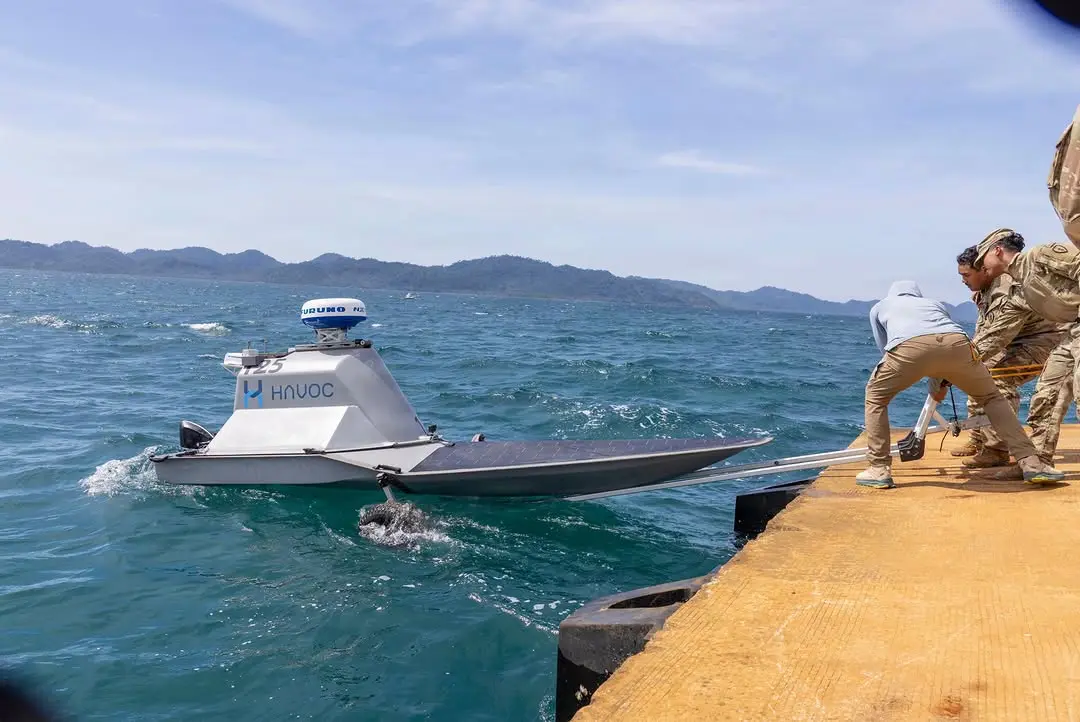
In mid-June, soldiers from the US Army’s 125th Intelligence and Electronic Warfare Battalion deployed a swarm of autonomous boats into Casiguran Sound on the Pacific coast of Luzon. The boats were solar-powered, fourteen feet long, and operated without crews. Their mission was to establish a maritime security screen around a US Army Logistics Support Vessel transporting Philippine Army armored personnel carriers more than 260 miles (nearly 420 kilometers) from Port Tobaco to Port Casiguran. The boats spread across the waterway, monitored the area around the ship, and relayed information to onshore personnel in near real time. When the ship reached port, they were recovered.
One year earlier, a different US Army unit, the 1st Multi-Domain Task Force, deployed a solar-powered fixed-wing drone over the Philippines during the same series of bilateral exercises. That drone provided persistent intelligence, surveillance, and communications relay for ground forces throughout the training event, running on sunlight, requiring no fuel, and staying aloft as long as needed.
Two different army units conducted separate exercises using two types of solar-powered autonomous systems, one in the air and the other on water. When examined together, these exercises showcase something more intentional and significant than what individual reports might suggest. The US Army is developing a persistent, solar-powered, autonomous surveillance-and-kill chain architecture across the Philippine Sea. This system will not be operated by the Navy but by land forces, deployable from beaches and designed to function indefinitely on solar energy.
The boat
The vessel in Casiguran Sound is the HavocAI Rampage. It was built by a Rhode Island startup co-founded by US Navy veterans Paul Lwin and Joe Turner, and it launched in early 2024. The Rampage is a fourteen-foot-long, all-electric, autonomous surface vessel. It is powered by a solar array that peaks at 315 watts, which HavocAI claims allows it to loiter indefinitely at low speeds.
At higher speeds, it has a 100-nautical-mile range, a top speed of 15 knots, and a 300-pound payload capacity. It is self-righting, connects via Starlink for beyond-line-of-sight communication, runs on mesh radio data links to coordinate with other boats in a swarm, and can be launched from a beach by four people using a dolly.
Each boat costs approximately $100,000. The US Army purchased a dozen of them. HavocAI’s chief executive has described this price point explicitly as the strategic goal. He said that the vessels are priced like munitions, where fielding and losing thousands of them is operationally acceptable rather than financially catastrophic.
The boat is equipped with a Furuno marine radar for surface search. Its payload bay can hold different mission packages, including cameras, infrared sensors, signals intelligence tools, communication relays, and electronic support measures. In future versions, it may also carry strike packages. HavocAI has shown that the Rampage can work with Vatn Systems’ Skelmir S6 unmanned underwater vehicles. This testing allows the boat to operate in both surface and underwater environments simultaneously.
The drone
The aircraft flying above Luzon is the Kraus Hamdani Aerospace K-1000 ULE. This is a fully electric, solar-powered unmanned aircraft designed for long-duration missions to gather intelligence and relay communications. The 1st Multi-Domain Task Force has used it in several exercises in the Philippines. It provides full-motion video for intelligence, surveillance, and reconnaissance, and serves as a communication link for ground forces operating in the islands’ difficult terrain.
Like the Rampage on the water below it, the K-1000 ULE runs on solar power and is designed to remain on station indefinitely, constrained by maintenance cycles rather than fuel loads. The 1st Multi-Domain Task Force was created specifically to address the challenge of operating across the vast distances and maritime terrain of the Indo-Pacific island chain environment.
It combines intelligence, firepower, cyber capabilities, electronic warfare, and space operations under Army control. This setup is meant to operate from small locations on islands rather than large military bases. The use of solar energy is key to this approach.
A surveillance system that needs regular fuel deliveries is vulnerable in a dangerous environment, where every supply ship and fuel depot can be targeted. In contrast, a sunlight-powered surveillance system does not rely on logistics and is difficult to attack.
The doctrine shift
The detail in both exercises that matters most for understanding what is actually being built here is which Army unit is operating each system.
The Rampage at Casiguran Sound was operated by the 125th Intelligence and Electronic Warfare Battalion. This is a land force unit whose primary mission is intelligence collection and electronic warfare in support of ground operations.
This unit is not a maritime unit and is not part of a group usually connected with surface ships. Its role in the maritime autonomous swarm exercise shows a clear choice to include maritime awareness in the Army’s intelligence and electronic warfare tasks, rather than limiting it to the Navy.
That integration matters because of what the Army’s shore-based fires infrastructure can do with the information these systems collect. The United States has deployed its Typhon ground-based intermediate-range missile system to the Philippines, a launcher capable of firing Tomahawk cruise missiles and SM-6 from ground positions.
A Rampage system detects, identifies, and tracks surface targets in the Luzon Strait. It sends this information to a land-based Typhon missile system, which completes the kill chain, enabling detection and a precise strike without requiring ships, aircraft, or naval platforms. The Army locates the target in the water and fires the missile from the ground.
Ben Outlaw, the industry partner representative present at the Casiguran Sound operation, said that the boats provide situational awareness “with their ability to find, fix, target, kill, and confirm,” and “the commander’s decision-making process has been compressed from hours to seconds.” This is kill-chain language, published on a US Army Pacific press release, describing a $100,000 solar boat in the Philippine Sea.
The Balikatan confirmation
In June, officials described the situation at Casiguran Sound as a means of ensuring maritime security for logistics. In April, during Balikatan 2026, the situation was explained more clearly. US Naval Institute News reported that HavocAI Rampage vessels were used in northern Luzon, along the South China Sea coast near the Luzon Strait.
Exercise planners called this a “littoral deep battle demonstration.” They planned to use the drones to “identify and cue artillery, missiles, and other attack drones to destroy an enemy landing operation.” This practice involved an enemy landing operation in the Luzon Strait, making the scenario clear.
The Luzon Strait is a 250-kilometer-wide passage located between the northern Philippines and Taiwan’s southern coast. Chinese naval ships traveling from the South China Sea to the Western Pacific go through this strait.
Any Chinese amphibious operation toward Taiwan’s southern flank would move through it. A persistent solar USV network in the strait provides continuous maritime domain awareness of exactly those movements, feeding an Army-operated ground-based fires network that does not require aircraft carrier battle groups to remain on station for its kill chain to function.
The economics
HavocAI raised $85 million in October 2025, bringing its total capital to nearly $100 million since launch. The investor list is the signal that this is no longer a technology demonstration by a startup. It includes In-Q-Tel, the CIA’s venture investment arm; Lockheed Martin; and two strategically significant allied-nation investors: Hanwha, the South Korean defense conglomerate, and Taiwania Capital, a Taiwan-based fund.
South Korea and Taiwan are not just watching a Rhode Island startup create solar-powered drone boats for exercises in the Philippine Sea. They are actually investing in this platform. Their investments indicate a strong interest in Rampage’s capabilities. This includes affordable, ongoing, and automated maritime surveillance that land forces can operate from islands without needing port infrastructure. This is important for both countries in the scenarios they care about most.
HavocAI currently operates contracts with the US Army, the US Navy, and the Defense Innovation Unit, with 32 vessels already deployed with DoD customers across Europe, the US east and west coasts, Hawaii, and now the Philippines.
Its software platform runs identically across the 14-foot Rampage, a 38-foot vessel, a 42-foot vessel, and a planned 100-foot platform capable of launching legacy missiles from an autonomous hull, eventually allowing the same swarm logic that coordinates 14-foot scout boats to coordinate an ocean-going strike vessel in the same formation.
The solar bid
A solar drone boat guiding a logistics ship through Philippine waters is an example of integrating technology. A solar fixed-wing drone that gathers intelligence for a ground team is a training activity. When these two are practiced together, with partners from other countries investing in the platform and military terms appearing in official Army announcements, they show the development of something more significant.
The US Army is creating a solar-powered network for surveillance and strikes that can operate autonomously across the first island chain. This network will be run by land forces from locations with minimal infrastructure. It is designed to operate continuously without fuel, especially in maritime areas where Chinese operations and possible landings could occur.
The surveillance system operates on solar energy above and over the water. The strike system is already set up in the Philippines. The connection between these systems is getting faster, moving from hours to seconds with each training exercise.
A $100,000 solar boat doesn’t replace a destroyer. However, if a thousand solar boats run on sunlight and launch from beaches, they can create a ground-based precision-fires network that is hard for an enemy to find and attack. It changes what a destroyer must do and where it must be located. This strategy is currently being tested in the Philippine Sea and is more advanced than many reports indicate.