Key ideas
- •China publicly showed the DF-17 launch for the first time, revealing the world's first operational hypersonic glide vehicle in action.
- •The DF-17 flies in an altitude band between THAAD and Patriot missile defenses, making it harder to track and intercept.
- •The exercise showed China training for mobile, multi-service missile operations under electronic warfare conditions.
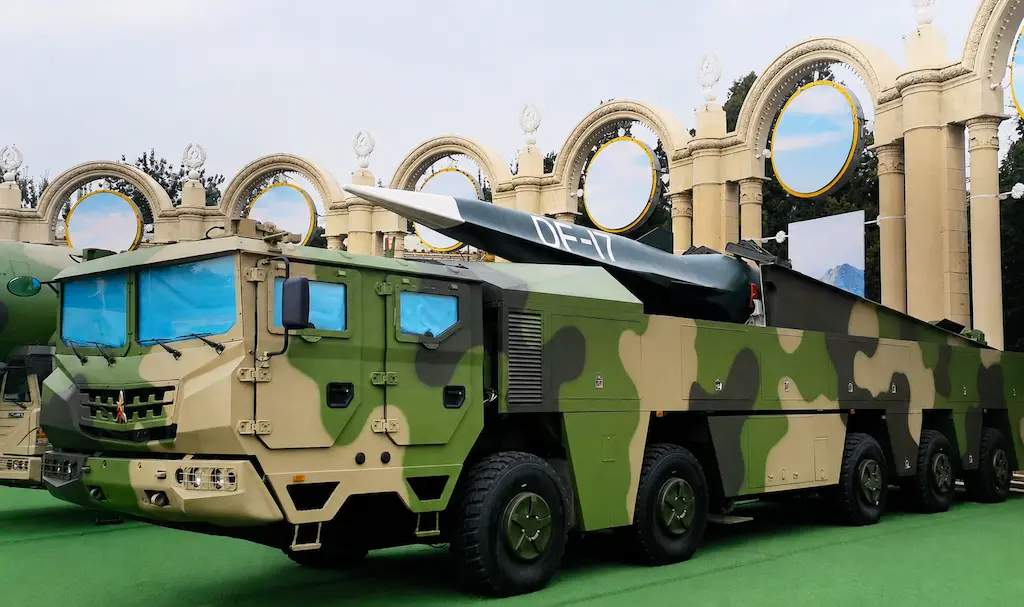
On Saturday, June 20, China’s state broadcaster CCTV showed two minutes of video that the People’s Liberation Army had not released before. The video featured the DF-17 hypersonic missile being launched from a transporter erector launcher parked on a highway in challenging terrain. The launch was part of a live exercise that also included the Army and Air Force working together in the Gobi Desert.
Military expert Du Wenlong told CCTV that this was the first time the public had seen a DF-17 missile launch. China has been using the DF-17 since at least 2019, and this week it decided to show the missile in action. Understanding what the footage shows and what else was included in the same broadcast is more important than the headline alone.
What is DF-17
The DF-17 is a medium-range ballistic missile that carries China’s DF-ZF hypersonic glide vehicle. The weapon has a special design that allows it to ride the shockwave it creates, gaining lift as it flies. The missile is about 11 meters long and weighs 15,000 kilograms. It’s solid-fueled, which allows for quick readiness, and has a range of 1,800 to 2,500 kilometers. Its glide vehicle can reach speeds between Mach 5 and Mach 10. The DF-17 became the world’s first operational hypersonic glide vehicle when it entered service with the PLA Rocket Force in 2019, ahead of similar systems from other countries.
A ballistic missile rises steeply into the atmosphere using its booster, travels through space, and then descends predictably. Intercept systems, like the United States’ THAAD, are designed to target this path. They work best at heights between 40 and 150 kilometers during the middle and end stages of a missile’s flight.
The DF-ZF hypersonic glide vehicle works differently from traditional missiles. After it separates from its booster, it does not travel in an arc into space and back down. Instead, it flattens its flight path, gliding at altitudes between 30 and 60 kilometers. This keeps it within the atmosphere, below the midcourse phase, where THAAD is most effective, but above the 25 to 30-kilometer altitude range where the Patriot PAC-3 works best. This altitude range is a gap in every missile defense system currently used in the Indo-Pacific. The DF-17 was designed to take advantage of this gap.
There are two extra complications. At high speeds, the air heats up, forming a plasma layer around the vehicle that disrupts radar signals and makes it much harder to track accurately. Unlike a ballistic missile, which follows a predictable path after its launch, the DF-ZF can change its direction both left and right and up and down while it glides.
With a vehicle that can change its flight path, this prediction becomes much more complicated. US defense officials shared testing results with Congress, confirming that the DF-ZF performed “extreme maneuvers” and “evasive actions” during flight tests, landing test warheads close to their intended targets.
The second disclosure
The DF-17 footage was the headline from Saturday’s CCTV broadcast. The more technically significant revelation may be a second missile that appeared in the same program.
A Rocket Force transporter-erector-launcher, similar to the DF-26, was seen setting up a missile. Military experts describe the missile’s shape as a bicone aerodynamic design, which has not been seen before on any Chinese missile. There were small control fins near the warhead. Du Wenlong explained on air that these fins allow the missile to change its flight path, enabling it to maneuver sideways and up and down during the final phase. It suggests an improved version of the DF-26 with a guided warhead rather than a standard ballistic reentry vehicle.
The DF-26, already one of the most powerful missiles in China’s arsenal, is an intermediate-range ballistic missile with a range of 3,000 to 5,000 kilometers, capable of reaching Guam from mainland China and targeting aircraft carriers at sea. It has earned the informal designation of “carrier killer.”
The existing DF-26 warhead follows a more predictable terminal trajectory compared to the DF-17’s glide vehicle. A DF-26 with active terminal maneuvering capability changes that assessment significantly, extending the same interception challenge the DF-17 poses to a missile with nearly twice the range.
What exercise revealed
The way Saturday’s joint exercise was organized provided valuable information, just as the equipment it demonstrated did. Launch units are set up at regular roadside positions on highways rather than at fixed launch sites. Fixed sites can be spotted by satellites, making them vulnerable to attacks. In contrast, highway-based operations enable launching from any point on China’s road network. This approach makes it much harder to target the Rocket Force’s strike capacity in advance.
Du Wenlong said “field operations have become the basic mode of combat” and that launch units can now shift “rapidly between operational modes in response to changing orders.” The Rocket Force is training to fight from wherever it happens to be, not from where it was expected to be.
The exercise also ran under simulated electromagnetic interference conditions, with units executing multiple sequential strike waves while training to operate in an environment where communications and positioning may be degraded. This is the scenario where an adversary’s electronic warfare assets, the kind the United States, Japan, and South Korea have invested heavily in, are actively attempting to disrupt missile operations. China’s Rocket Force is training to launch the DF-17 anyway.
The exercise involved all PLA military branches. Rocket Force units worked alongside Army and Air Force teams simultaneously. CCTV noted that “streamlined command chains” reduced the time between ordering and launching strikes. This improvement reflects years of teamwork aimed at closing the gaps that have often made joint military operations difficult. A Rocket Force strike is no longer an isolated event; it now marks the beginning of a conflict.
The geography
From launch sites at Base 61 in eastern China, the Rocket Force focuses its conventional missile brigades mainly on Taiwan. The DF-17 missile can reach all of Taiwan, Japan, and important US military bases like Kadena Air Base in Okinawa and Misawa in northern Honshu, as well as every US and allied military position in South Korea. It takes about three to four minutes for the missile to travel to Kadena at Mach 8 from the time a warning is issued until impact.
Japan deploys Aegis-equipped destroyers equipped with SM-3 Block IIA interceptors, designed for exoatmospheric interception of ballistic missiles in their midcourse phase. The DF-17’s glide vehicle operates inside the atmosphere. South Korea’s THAAD battery in Seongju has not been tested against hypersonic glide vehicles and was not designed for the altitude band at which the DF-ZF operates. Taiwan’s Patriot PAC-3 batteries have a ceiling well below the DF-17’s operational altitude during most of its flight.
None of these systems was designed to counter what Saturday’s footage showed. None of them is currently certified for that purpose. In India, the DF-17’s range does not cover most of the country from obvious launch positions in eastern China. However, the upgraded DF-26 variant shown in the same broadcast is a different story.
The DF-26’s base range of 3,000 to 5,000 kilometers reaches India’s eastern military airbases, including Bagdogra, Jorhat, Chabua, and Tezpur, as well as the strategic infrastructure in the Northeast. India’s S-400 batteries are highly capable against aircraft and conventional cruise missiles. Against a ballistic missile with terminal maneuvering capability, the same altitude-gap problem applies.
The timing
China did not release the first public footage of a DF-17 launch on a random Saturday. US-Iran negotiations are underway in Switzerland. President Trump’s visit to Beijing is scheduled for next month. The Trump administration has reportedly delayed announcing a Taiwan arms sale to avoid complicating negotiations with China’s leadership.
CCTV aired live footage of the DF-17 launch on state television for the first time. A military commentator mentioned this was the first time the public could see it to send a strong message.
For Taiwan, it shows that the most dangerous part of any conflict starts with attacks that can’t be stopped. For Japan and South Korea, it confirms that their missile defense systems have real gaps. For Washington, it highlights that while discussions take place in Switzerland over one regional issue, a significant threat is emerging in the Gobi Desert.
China has been demonstrating its Rocket Force for years. What changed on Saturday was that it publicly demonstrated, for the first time, what that force looks like when it actually fires.