Key ideas
- •India has completed the full indigenisation of the AK-203 rifle, with every component now sourced from Indian manufacturers instead of relying on Russian parts.
- •The Korwa factory plans to dramatically accelerate production, targeting one rifle every 100 seconds, or about 600 rifles a day, to complete the 601,427-rifle order ahead of schedule.
- •The fully Indian-made AK-203 prototypes will undergo Indian Army testing in September 2026, marking the next major test of whether India's domestic small-arms supply chain can match the performance of the Russian-origin design.
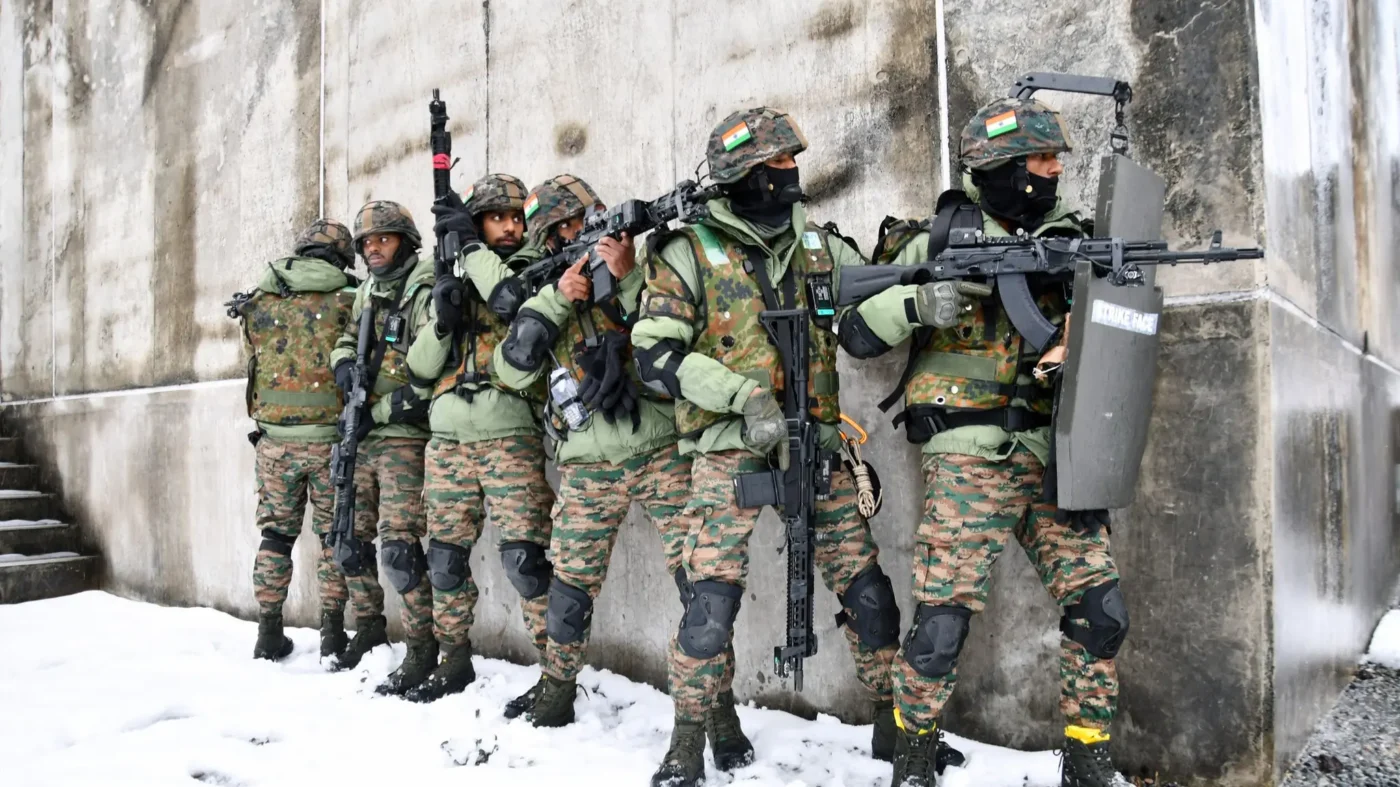
The factory at Korwa in Amethi, Uttar Pradesh, just three hours away from New Delhi, has been making AK-203 assault rifles for the Indian Army since 2022. Until now, these rifles were assembled using a mix of Indian and Russian parts. The design was Russian, and while manufacturing became more localised over time, India still depended on Russian components. But not anymore.
Major General SK Sharma, the CEO and Managing Director of Indo-Russian Rifles Private Limited (IRRPL), announced that IRRPL has successfully produced and fired the first AK-203 rifle made entirely with Indian materials.
Every part, including the barrel, receiver, gas system, trigger assembly, springs, and other components, comes from Indian manufacturers. The key partners in this effort include Advanced Weapons and Equipment India Limited (AWEIL) and various Indian small and medium-sized enterprises (MSMEs), which together supply about 50 parts and 180 sub-parts across 120 manufacturing processes.
The prototypes will be given to the Indian Army for testing in September 2026. Making the AK-203 locally is not easy. Each rifle requires 120 manufacturing processes and includes around 50 different parts. The complexity is challenging for many small arms manufacturers outside Russia, Europe, and the United States to replicate at scale.
IRRPL was established in 2019 as a joint venture between Indian public defence companies AWEIL and Munitions India Limited, which hold 50.5 per cent, and Russia’s Rosoboronexport and Concern Kalashnikov, which hold 49.5 per cent. The goal has always been full indigenisation, which involves creating a domestic supply chain for small arms manufacturing that did not previously exist in India at this level of quality.
Since commercial production began, 60 critical components have been indigenised. This week’s announcement marks the completion of this process, which means IRRPL is no longer using any imported parts.
IRRPL plans to increase its production rate to one rifle every 100 seconds. It would allow the factory to produce 600 rifles daily. Over 300 working days each year, that totals 180,000 rifles annually, against a total order of 601,427 rifles. At this rate, they expect to complete the order in about three and a half years.
Major General Sharma stated that this achievement in indigenisation and capacity improvements means IRRPL can deliver the approximately 600,000 rifles almost a year earlier than originally planned. By late 2025, around 53,000 rifles had already been delivered. The pace of delivery changes significantly, as they aim to deliver 70,000 rifles by the end of 2025, with the rest of the order expected by 2030.
Making an indigenous rifle is important for India because it depends on weapons from Russia. Many of its military systems, such as the Su-30MKI and MiG-29 fighter jets, T-90 tanks, and various missiles, use Russian components. Since February 2022, geopolitical tensions have disrupted this supply. A rifle made entirely from Indian components and produced in India will give India more control over its operations, unlike other weapons that still rely on foreign supplies.
IRRPL’s trials with the Army in September 2026 will determine if the fully indigenised prototype meets the same standards as those made with Russian components. If successful, the factory will produce one rifle every 100 seconds, 600 rifles each day, using only Indian materials and requiring no imports.