Key ideas
- •Ukraine's new TrophyLab platform gives approved users access to four years of research on more than 115 captured Russian weapons systems.
- •The database includes weapon families linked to India's BrahMos missile, T-90 tanks and Su-30 fighters, all of which share Russian origins.
- •For India, the challenge is that many countries may gain access to detailed studies of Russian systems that form the backbone of its military.
Ukraine’s Ministry of Defense launched TrophyLab on June 19, a platform that allows approved defense manufacturers, research institutions, and allied governments to access technical drawings, component analyses, research findings, and physical samples from more than 115 pieces of captured Russian military equipment across 79 categories.
The platform was built on four years of systematic forensic work by Ukraine’s Armed Forces, Defense Intelligence, Security Service, and specialized research labs, analyzing every piece of Russian hardware recovered from the battlefield. The catalog includes rocket and missile weapons, sea-launched cruise missiles, armored vehicles and equipment, aircraft, UAVs, electronic warfare systems, and unmanned ground vehicles.
For most of the defense industry in Europe and North America, TrophyLab provides verified data on adversary systems that would otherwise take years and considerable intelligence resources to acquire independently. For India, the calculation is considerably more complicated.
The platform
Ukraine’s Defense Minister Mykhailo Fedorov said, “Every missile, drone, and vehicle seized on the battlefield is now a source of knowledge for the free world.” Access requires registration, identity verification, and signing an agreement with the Ukrainian Ministry of Defense. Approved users can access the full catalog online, commission further research from Ukrainian laboratories, or request physical samples for their own offline analysis, including testing that involves full disassembly or destruction of the system.
Ukraine’s Prime Minister Yulia Svyrydenko confirmed that access is available to Ukrainian scientific organizations, defense units, defense technology manufacturers, government agencies, defense ministries of partner countries, and foreign defense companies of partner states that meet the Ministry of Defense’s requirements.
The first important point in this story is the eligibility framework. India is not officially a partner country of Ukraine. Throughout the conflict, India has stayed neutral. It has not voted at the UN to condemn Russia’s invasion and continues to buy weapons and energy from Russia. India has not officially aligned with either side. Because of this, India is unlikely to meet the criteria needed to access the platform. The countries that will gain access are mostly Western allies, NATO members, and those that have openly supported Ukraine.
Some of those states are also potential adversaries, competitors, or intelligence targets of India. And the database that those states now access contains forensic documentation of the weapons systems India has fielded in large numbers for decades.
The missile problem
Since May 2022, Russia has regularly launched the P-800 Oniks supersonic cruise missile at targets in Ukraine. These missiles are fired from Bastion-P coastal defense systems in Crimea, from surface ships, and from submarines. By late 2022, Russia had used over 120 Oniks missiles against Ukraine. Each missile fired leaves wreckage that Ukraine can recover and analyze. The P-800 Oniks is the technical ancestor of the BrahMos missile.
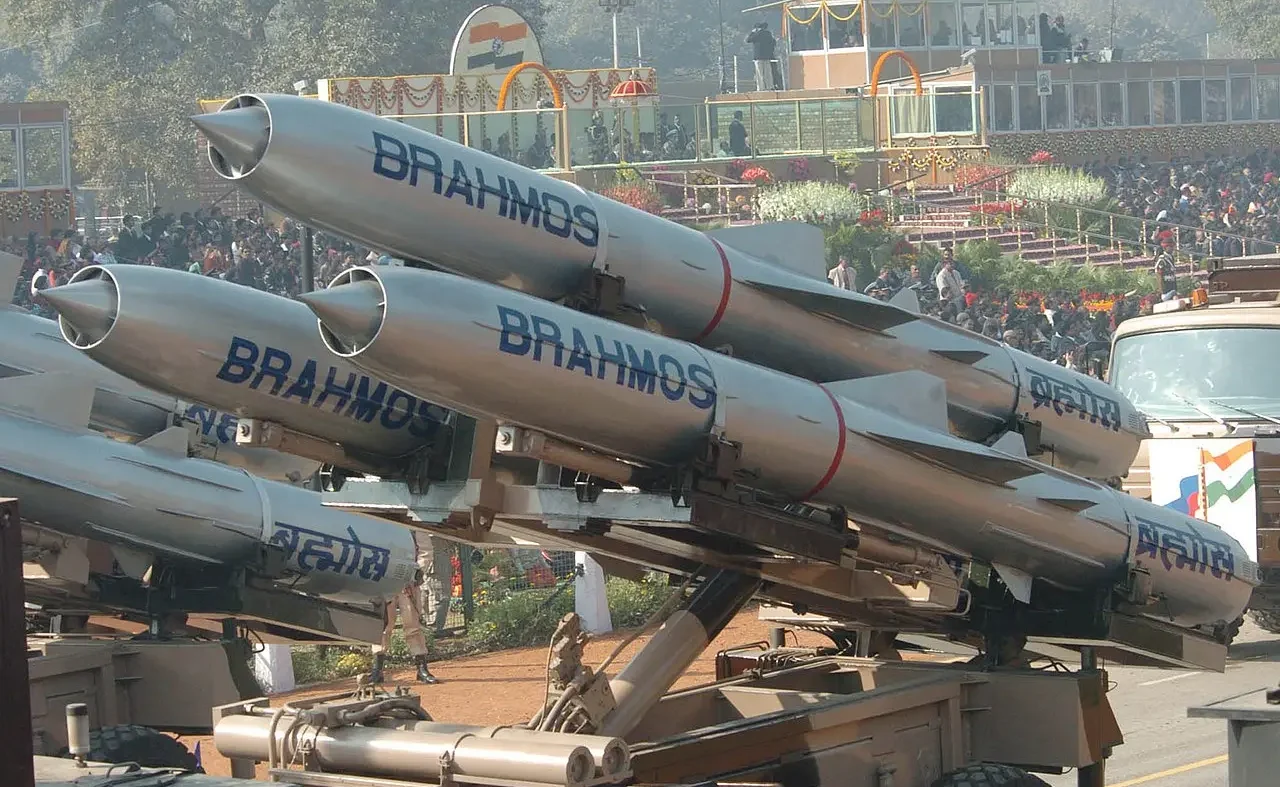
BrahMos Aerospace is India’s main supersonic cruise missile program. It started in 1998 as a partnership between India’s DRDO and Russia’s NPO Mashinostroyeniya, the same design bureau that created the P-800 missile. The BrahMos missile is based on the P-800 Yakhont export model. It includes Indian-built guidance systems, as well as avionics from Israel and France. The BrahMos missile also has a longer range, can be launched from the air, and works on multiple platforms, which the original Oniks model did not have.
However, the two missiles are not the same system. BrahMos is, in many respects, a generation ahead of the Oniks it was derived from, with ranges extending to 450 kilometers and beyond in its latest variants, versus the export-restricted Yakhont at 120 to 300 kilometers.
But they share a propulsion architecture: a solid-fuel booster for initial acceleration, followed by a kerosene-fueled ramjet for sustained supersonic flight. They share a lineage in seeker design, originally active radar. They share the design philosophy of the same bureau that built both. A thorough component-level teardown of the P-800, of the kind Ukraine has been conducting for 4 years and that TrophyLab is now formalizing, reveals details about design choices, materials, and engineering trade-offs that carry over across the family.
TrophyLab’s catalog explicitly includes rocket and missile weapons, as well as sea-launched cruise missiles, as categories. The P-800 Oniks falls squarely across both.
The tanks and aircraft
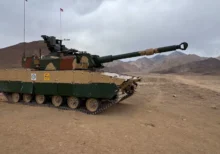
India’s Army tank fleet runs roughly two-thirds T-72M1 and thirty percent T-90S, with more than 1,400 T-90S units built under license domestically at the Heavy Vehicles Factory in Chennai. Ukraine has captured and forensically studied the T-72 and T-90 family armor extensively throughout the conflict.
The T-90M specifically appears in the imagery on TrophyLab’s homepage. The T-90M is a later variant than the T-90S India operates, with upgraded Relikt explosive reactive armor, an improved Kalina fire control system, and a modernized engine. The underlying platform family is shared.
The Su-30MKI is the main aircraft in India’s Air Force, with about 270 in service. It is manufactured under license by Hindustan Aeronautics Limited and makes up more than 70% of the IAF’s attack aircraft. Russia uses the Su-30SM and Su-30SM2, which are different versions of the same Sukhoi design. Ukraine has captured a Russian Su-30 and is studying it.
TrophyLab’s catalog includes aircraft as a category. The avionics, radar systems, and electronic warfare suite on India’s Su-30MKI differ from those on the Russian variants. India’s version incorporates substantial Israeli, French, and Indian-developed systems layered onto the airframe. But the airframe design, thrust vectoring system, and many structural elements share common lineage with what Ukraine has been examining.
The reverse problem
There is a second dimension to this that further complicates India’s position and runs in the opposite direction. In April 2025, Ukraine’s Defense Intelligence published a component analysis of six Russian weapon systems and, for the first time, identified an Indian-origin component.
A clock buffer made by Aura Semiconductor, a Bengaluru-based company, was found in a Russian weapon. Ukraine’s Defense Intelligence said this shows Russia is trying to obtain parts by circumventing Western sanctions. For India, this discovery raises concerns about how well supply chains are being monitored and how Indian-made parts are ending up in Russian weapons that are attacking Ukrainian cities.
BrahMos Aerospace is a joint venture with NPO Mashinostroyeniya, a Russian company known for the P-800 missile, which is currently being studied in Ukraine. The partnership between these two companies began before the war and has not officially ended. This creates uncertainty about how technical knowledge is shared between them.
However, TrophyLab does not directly compromise BrahMos or India’s weapons systems. It focuses on Russian platforms, not Indian ones. BrahMos is a well-developed version with sufficient independent engineering, so data from the P-800 does not directly affect BrahMos’s vulnerability.
But Ukraine has conducted four years of detailed forensic work on the weapons it uses most, and this information is now being shared with defense manufacturers and governments, including some of India’s arms suppliers and strategic partners, as well as potential competitors.
Everyone can now access data on the T-90 tank’s armor materials, how its reactive armor works, its fire control systems, and maintenance needs, as well as the P-800 missile’s engine, guidance system, and target acquisition. Additionally, the Su-30 aircraft’s structure and electronic signatures are available.
India’s defense planning has typically assumed that details about Russian-made systems stay largely between India and Russia. Today, TrophyLab was launched as a formal challenge to that assumption. It doesn’t focus on Indian systems; instead, it rigorously documents their origins and shares this information with the global defense industry. However, due to its strategic position, India cannot access the framework used to distribute this documentation.