Key ideas
- •The US is developing a 500-kW laser capable of destroying drones in seconds, marking a major leap in directed-energy weapons.
- •Chinese researchers are pursuing four countermeasures, including heat-resistant coatings, metamaterials, thermal shielding, and swarm tactics.
- •Experts say the next phase of drone warfare will be driven by the race between more powerful lasers and drones designed to survive them.
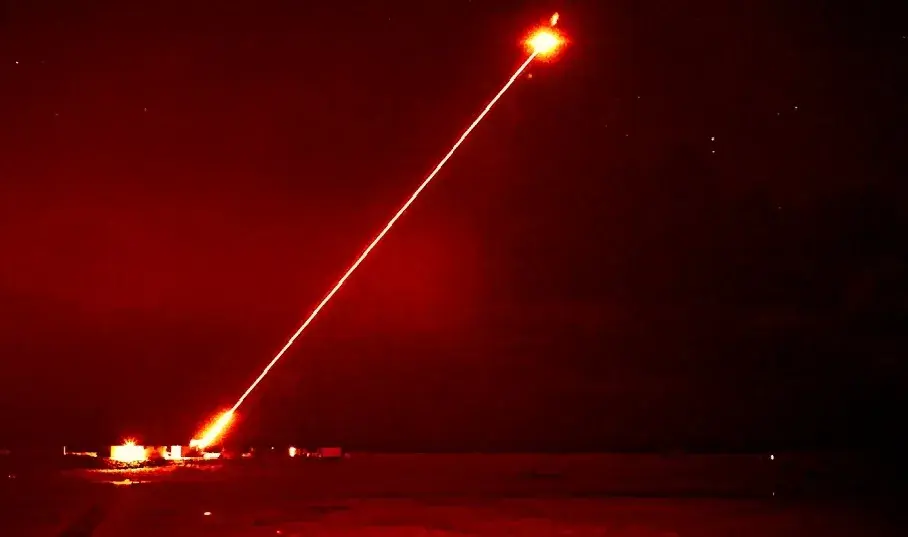
The US Department of Defense has awarded Lockheed Martin a contract to develop the Joint Laser Weapon System. According to Lockheed, the system is a tactical, containerized laser weapon that uses 500 kilowatts of power and provides military commanders with flexible, cost-effective options for intercepting threats.
A 500-kilowatt laser is five times as powerful as Israel’s Iron Beam, which is currently the most tested and successful directed-energy weapon. At this power level, the way a laser weapon destroys a drone changes significantly. It is important for anyone designing a drone to ensure it can survive an attack.
What happens when a laser hits a drone
A laser weapon does not instantly vaporize a drone. Instead, it focuses heat on one spot for long enough to cause that area to fail. Most modern military drones are made from carbon fiber, which starts to burn at about 600 to 700 degrees Celsius. Drone electronics fail between 70 and 150 degrees Celsius, while motors lose strength between 150 and 400 degrees. The laser only needs to reach the failure temperature at a specific point; it does not have to melt the whole drone.
Israel’s Iron Beam, which operates at 100 kilowatts, requires 5 to 15 seconds of continuous targeting to take down a typical military-grade drone. If it operates at 500 kilowatts, it can achieve the same effect in roughly three seconds. If the laser is more precise, it is possible to engage some targets in less than a second.
When designing a drone that needs to survive a laser attack, the key question is whether the designer can make it last long enough to complete its mission before the laser inflicts damage. There are four engineering methods being developed to address this issue, and China is working on all of them.
The ablative answer
The best way to handle a laser heating a drone is not to try to stop the heat. Instead, this approach accepts that the laser will cause heat and creates a protective outer layer. The layer then absorbs heat by vaporizing, preventing it from reaching the drone’s underlying structure.
Ablative materials protect surfaces by changing from solid to gas in a controlled way. When a laser hits an ablative coating, the material turns into gas. The process absorbs a large amount of energy, called the latent heat of vaporization, preventing that heat from being conducted inward to the rest of the structure. The method is similar to the heat shield used on a space capsule during reentry into the atmosphere. Rather than resisting high temperatures, the heat shield sacrifices itself to dissipate heat.
The materials being created for laser-resistant drones are very advanced. Ultra-High-Temperature Ceramics, such as zirconium diboride, hafnium diboride, tantalum carbide, and zirconium carbide, can withstand temperatures ranging from 3,246 to 3,768 degrees Celsius. These numbers come from real materials science, not rough estimates.
A type of carbon fiber-reinforced ceramic composite with added Ti3SiC2 has been shown in Chinese research to withstand 1,600 degrees Celsius. It has a very slow wear rate, consuming only 0.00853 millimeters per second. This means that even with prolonged laser exposure, the underlying structure is not revealed for a long time.
Chinese researchers published a study in the Journal of Laser Applications about coatings made from Refractory High-Entropy Alloys on titanium alloys. These coatings are designed to resist extreme thermal oxidation using laser cladding techniques. Among the options, the Mo30 coating exhibited the best oxidation resistance. Its oxidation process follows a parabolic pattern, which is important because it indicates that the oxide layer forms during heating and limits further oxidation rather than accelerating it.
The main engineering challenge is mass. Every gram of ablative coating reduces the drone’s ability to carry payload or fuel, or to make its airframe. A coating that provides sufficient protection to extend the laser’s runtime also adds weight, reducing the drone’s range, payload, and speed.
The key question, how much protection can we get for each kilogram of weight, remains unanswered for production systems. This will determine whether ablative coatings can be used in the field or remain just a lab idea.
The reflective approach
A simple solution for a laser is a mirror. If a laser focuses heat by adding energy, a surface that reflects 99.99 percent of that energy should be safe from it. Dielectric mirrors, made of layers of materials with different optical properties, can reach these high reflectivity levels in a lab. However, when used on a drone, the physics can be more challenging.
A reflective coating can reflect 99.99 percent of incoming energy, which means it still absorbs 0.01 percent. For a 100-kilowatt laser, this absorption results in 10 watts continuously striking the coating’s surface, similar to a high-power laser focused on a single spot.
With a 500-kilowatt system, the absorption rises to 50 watts. This energy causes the coating to heat up. Since even the best reflective coatings are not perfectly uniform, uneven absorption creates hot spots that cause faster wear. The coating can melt or vaporize, exposing the surface underneath in just fractions of a second.
The main issue is that dielectric mirrors only reflect certain wavelengths well. These mirrors can effectively reflect a narrow range of light. However, laser weapons can operate at different frequencies. If a coating is designed to work well for one type of laser, it may not work for another. If an enemy knows which wavelengths their opponent’s drone protection uses, they can simply change the frequency of their laser.
The solution for targeting specific wavelengths is metamaterials. These materials are specially designed with unique optical properties that do not exist in nature. They can respond to laser energy across multiple wavelengths simultaneously.
Since 2023, China has been developing specialized materials to protect against laser attacks. These coatings can either reflect or absorb laser energy. Creating these materials is difficult because they must respond accurately to different wavelengths while remaining light enough to attach to drones.
In the United States, the Air Force is also funding research on spray-on coatings made from engineered nanoparticles. These coatings could be applied before missions, when the target laser system’s wavelength is known.
Thermal transport delay
The third approach recognizes that heat can get into the drone’s structure. It aims to slow the rate at which heat reaches important parts. Using materials such as ceramic foam, aerogel insulation, and specialized thermal barriers between the outer shell and the electronics, battery, and motor can help delay failures. The method works even if the outer surface starts to break down.
It is the same principle that gives buildings fire ratings. The structural steel does not resist the fire; it is separated from the fire by materials that transfer heat slowly enough to provide evacuation time. Applied to a drone, a thermal transport delay system adds seconds to the effective dwell time required before the electronics reach failure temperature.
Seconds are crucial because a laser system must account for the time required to find a target, maintain the beam, and confirm each engagement. Thermal delay means there is a wait, not a complete halt. A 500-kilowatt laser operating at high, continuous power will eventually produce enough energy to penetrate any practical insulation on an airborne platform.
Using thermal transport delay works best with ablative outer layers. The ablative surface initially protects against intense heat, while the insulation layer slows heat transfer during and after the material burns away.
The answer that probably matters most
All three material-based methods have a weakness. The methods attempt to solve a physics problem through engineering, and this problem becomes more difficult at higher laser power. A 100-kilowatt laser gives drone designers some time; fifteen seconds is enough to take effective action.
However, a 500-kilowatt laser reduces that time to three seconds or less. Future systems that reach one megawatt, which countries such as the United States and China are exploring, would cut response times to fractions of a second, regardless of protective coatings.
China’s main published response to laser weapons is not a material; it is a number. A peer-reviewed paper in the journal Command Control and Simulation, authored by Chinese researchers and titled “Constructing Naval Counter-Swarm Systems,” proposed the logic explicitly. A high-energy laser weapon, regardless of its power level, can engage only one target at a time.
Acquiring a target, adjusting the beam to keep it on the target, confirming destruction, and then moving to the next target takes time, even for advanced automated systems. If each engagement takes two seconds, which is optimistic for systems with mechanical or optical beam-steering parts, then hitting fifty targets will take one hundred seconds, and hitting one hundred targets will take two hundred seconds.
A drone swarm traveling at 120 miles per hour will reach its target in 60 seconds from a distance of 2 miles. If there are more drones in the swarm than the laser can target in that time, some drones will get away. The numbers don’t match, and simply increasing the laser’s power won’t easily fix the problem. This issue comes not just from the laser’s energy, but also from how the targeting system works and processes information.
In March 2026, China’s CCTV reported on its laser systems designed to stop drones. The report pointed out a specific problem. Fiber-optic drones use physical cables to communicate instead of radio signals. This means that these drones cannot be jammed using electronic methods.
When a laser weapon targets a group of fiber-optic drones, it cannot disable them all at once by jamming. Each drone must be destroyed individually. If the drones have special coatings that increase the time the laser needs to work, it takes six seconds instead of three. As a result, a 500-kilowatt laser can only take down five drones per minute instead of ten. This means the swarm can reach its target before it is completely stopped.
The race Lockheed just entered
The 500-kilowatt Joint Laser Weapon System contract does not settle this contest; instead, it starts a new phase. This system offers a significant improvement over existing technology.
At this power level, lasers can quickly engage individual drones, enabling interception of both commercial and military drones that have been prominent in recent conflicts. However, against the advanced, coated drones that Chinese researchers are developing, the 500-kilowatt system addresses last year’s threats rather than future ones.
The science behind laser weapons and how to counter them is constantly changing. High-power lasers work quickly but for a shorter duration. Ablative coatings help extend the time a laser can work. Reflective coatings are designed for different wavelengths of light, and metamaterials make them more sensitive to those wavelengths.
Swarm tactics can overwhelm the system’s ability to engage, while networked multi-laser systems try to share the targeting effort. Each new solution creates the need for another response in this ongoing cycle. A coating that can withstand temperatures up to 3,500 degrees Celsius is available in materials science labs.
The challenge is whether this coating can be used on a production drone without exceeding weight limits, staying within budget, and being produced quickly enough to meet demand. China is working on both industrial and engineering challenges simultaneously.