Key ideas
- •Qihoo 360 claims it built China's answer to Anthropic's AI vulnerability hunter, Mythos.
- •Five Eyes warns AI-powered cyberattacks could overwhelm today's defenses within months.
- •China is calling AI vulnerability discovery the new era of cyber deterrence.
Two days after leaders from the world’s top intelligence agencies warned the public about risks from artificial intelligence and cyber threats, the founder of a Chinese cybersecurity company linked to China’s intelligence ministry spoke at an event in China. He used language similar to what countries used to describe nuclear weapons during the Cold War.
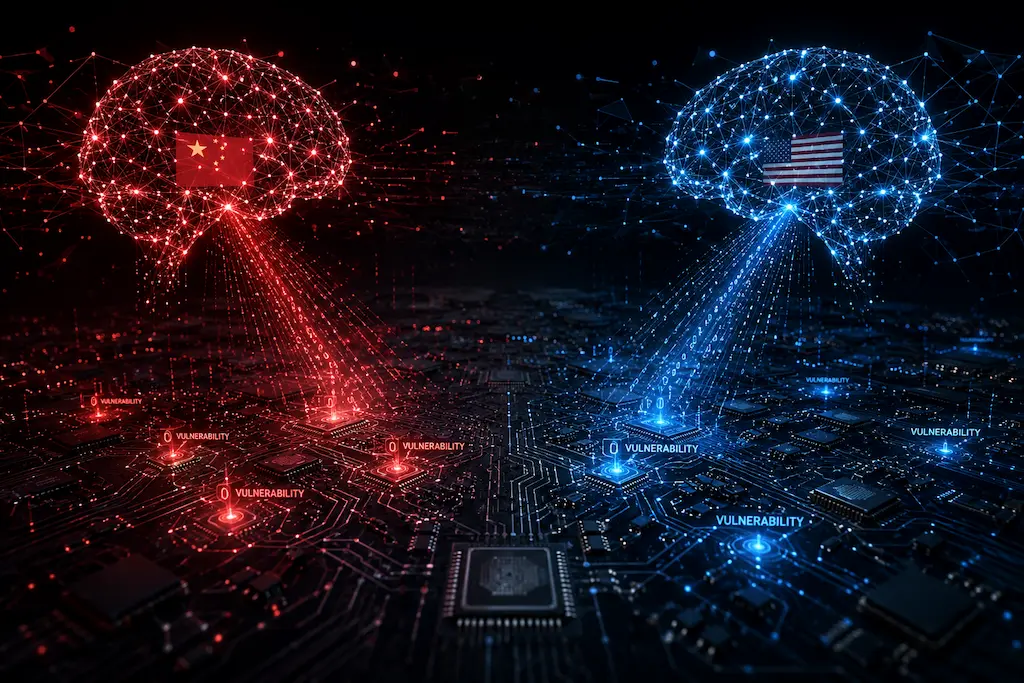
On June 23, the Five Eyes alliance, comprising the United States, the United Kingdom, Canada, Australia, and New Zealand, issued a warning. The group stated that AI models could soon launch cyberattacks to overwhelm government and business defenses. The alliance believes these threats are just months, not years, away and urged governments and business leaders to take immediate action to strengthen their defenses.
The agencies stated that the evolving world of artificial intelligence is rapidly reshaping cyber risks, and we must act quickly to keep up. The warning came after Anthropic announced in April that its Mythos models could find software weaknesses like never before. The security agencies pointed out that AI makes it easier for bad actors to attack while also speeding up and complicating those attacks.
Two days later, on June 25, at an internet security conference in China, Zhou Hongyi, founder and chief executive of Qihoo 360, reportedly said that Anthropic’s Mythos was the equivalent of a cyber nuclear weapon in the AI era and a strategic asset to the United States.
He said his own company had built a system called Tulongfeng, which he described as a Chinese version of Mythos with similar vulnerability-discovery capabilities. He said that while it was not as powerful as Mythos, it could be paired with Qihoo’s other technologies to produce a hacking tool of comparable effect.
“Previously, nuclear weapons constituted strategic deterrence. In the future, vulnerability discovery capabilities may become the new strategic deterrent,” Zhou said. “China’s cybersecurity industry must possess its own Mythos. This game-changing weapon of mass destruction cannot remain solely in the hands of others.”
The company making the claim is not a bystander
It might seem that Zhou is just using flashy language to promote his product against a well-known American competitor. However, it’s harder to see it that way when we look at Qihoo 360’s actual market position.
On June 8, the Pentagon’s updated Section 1260H list designated Qihoo 360 as directly and indirectly affiliated with China’s Ministry of Industry and Information Technology and its Ministry of State Security, and identified it as a military-civil fusion contributor to the Chinese defense industrial base due to those affiliations.
That update, published June 8 and expanded the list to 188 Chinese entities, moved coverage beyond traditional defense and infrastructure sectors into electric vehicles, artificial intelligence, semiconductors, batteries, biotech, robotics, and renewable energy, with 360 Security Technology named alongside Alibaba, Baidu, SenseTime, CloudWalk, and Yitu among the newly added technology firms.
The Ministry of State Security is China’s main agency for civilian intelligence and counterintelligence. It focuses on gathering foreign intelligence and ensuring domestic security. A Pentagon document linking a company’s leadership directly to this ministry is very different from that of a company operating only in China’s technology sector.
When the chief executive of that company stands up and declares that his country’s cybersecurity industry must possess its own version of America’s most capable AI vulnerability-discovery system, the statement carries weight beyond ordinary corporate rivalry.
In March 2025, Xi Jinping and Chinese military leaders announced plans to increase military investment, including research into technologies for both military and civilian use, such as cyber warfare, underwater systems, and autonomous weapons. These plans received support from Beijing’s 15th Five-Year Plan, which was released in March 2026.
The plan seeks to link advanced manufacturing with new combat skills to connect China’s military and industry better. Cyber capabilities are an important part of this effort, just as missile programs are.
What triggered the Five Eyes warning
The statement from the Five Eyes group, made two days before Zhou’s comments, followed reports that the Trump administration told Anthropic to restrict access to its Fable and Mythos AI models for foreign nationals. The decision came after these models showed a strong ability to exploit important software weaknesses. Concerns were specifically raised about Anthropic’s Mythos Preview and other models that already showed dangerous potential, even with safety features included in their design.
One claim related to this story needs more careful consideration than it has received. A report from The Economist said that an Anthropic AI agent could access almost all classified systems managed by the NSA and US Cyber Command within hours. This claim has not been confirmed by multiple independent sources, so it should be viewed as unverified rather than a fact.
What is confirmed is the concern that drives the Five Eyes statement. Experts expect that advanced AI models will surpass current industry expectations and radically change both offensive and defensive cyber capabilities.
The Five Eyes advisory took a serious tone and provided clear guidance for organizations. It urged them to invest in stronger cyber defenses, update legacy systems, fix software flaws, and limit access to essential systems. It also pointed out that AI can be both a threat and part of the solution. Organizations that use AI tools in their security can find vulnerabilities sooner, improve software quality, monitor unusual behavior, and respond to incidents more quickly.
A claim worth treating skeptically
Zhou says that Tulongfeng is almost the same as Mythos. However, this is just his opinion, and he has not provided proof. No technical comparisons have been shared to support his claim; it relies solely on his conference presentation and lacks any independent review.
This is not a single event. Anthropic has separately accused Chinese technology giant Alibaba of attempting to copy its AI systems, claiming in a letter to Congress that Alibaba sent millions of queries to its Claude chatbot in an attempt to reverse-engineer the underlying technology, a technique sometimes called a distillation attack.
Whether Tulongfeng itself employed any comparable technique is not established by the available reporting, but the broader pattern of Chinese firms rapidly replicating frontier American AI capabilities is now a recurring feature of this competition rather than an isolated incident.
What changed on June 25 was not a technical capability. It was the language a senior Chinese technology executive at a company the Pentagon has tied to China’s intelligence ministry chose to use publicly to describe the strategic significance of AI vulnerability-discovery systems.
Nuclear deterrence theory suggests that countries avoid conflict because they know that a first attack would lead to severe consequences for both sides. When this idea is applied to AI-based cyber capabilities, it means countries will want to have similar offensive AI cyber tools, just like they did with nuclear weapons during the Cold War.
Zhou states that the ability to find vulnerabilities in systems is now the new way to deter threats. Therefore, no government can afford to let this capability remain only with a rival country. It is unclear if Tulongfeng can actually deliver on its promises. However, it is confirmed that their leadership has made these claims. The US government already lists this company as having ties to China’s military and intelligence efforts.
The Five Eyes alliance warned that the world has only a few months to prepare for AI-enabled cyberattacks that could overwhelm current security systems. Two days later, China’s cybersecurity sector responded with language reminiscent of nuclear deterrence. Both sides describe the same emerging situation, but from different perspectives.