Key ideas
- •Project Zorawar was developed after the 2020 Galwan clash to give India a light tank built for high-altitude warfare.
- •Keeping the tank under 25 tonnes is critical for rapid airlift, mountain mobility, and operations in the Himalayas.
- •Modern threats such as FPV drones, loitering munitions, and top-attack missiles are reshaping how light tanks are designed and protected.
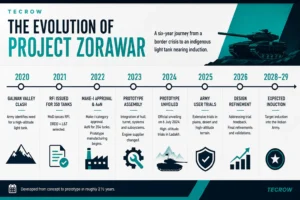
In June 2020, Indian soldiers died fighting hand-to-hand in a river valley in Ladakh because the adversary on the other side had thought more carefully than we had about what it means to fight in the mountains. The Chinese People’s Liberation Army arrived at the Line of Actual Control in Eastern Ladakh in April and May of that year with mechanised formations specifically equipped for high-altitude operations.
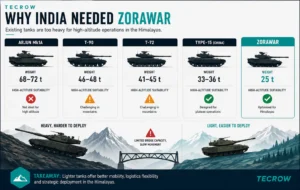
India’s armoured response, the T-72 Ajeya at 41 to 45 tonnes, the T-90 Bhishma at 46 to 48 tonnes, and the Arjun Mk-1A at a staggering 68 to 72 tonnes, could be moved to Ladakh, but could not operate freely across all of the mountainous battlespace it was needed to dominate. The Chinese had already deployed the Type-15, but India had nothing that matched it.
What followed was an extraordinary step that happens rarely in the Indian defence ecosystem. In collaboration with the Indian Army, India’s defence industry began developing a new light tank called Project Zorawar. The tank is designed to perform well in its intended combat zones and is developed locally, which is commendable for a country that often relies on imports.
The Defence Research and Development Organisation (DRDO), along with Larsen and Toubro, developed a working prototype in about two and a half years and unveiled it at L&T’s facility in Hazira, Gujarat, on July 6, 2024. Prime Minister Modi visited the same facility in June 2026 to check on its progress. The tank then underwent high-altitude tests in Nyoma, Ladakh, and successfully launched the Nag Mk-2 anti-tank missile, developed by DRDO and produced by Bharat Dynamics Limited (BDL), from the tank at the Pokhran range.
Overall, the Zorawar project has successfully met its development goals. But a technical success and an operational success are different things. And right now, the Indian Army is being asked to choose between the two.
The Zorawar light tank
Initially, the goal was to introduce a light tank that weighs about 25 tonnes. It should perform well at high altitudes and have a modular design. The tank needs to be easy to deploy quickly, reach areas where the T-90 and Arjun tanks cannot go, and do so faster than either of them.
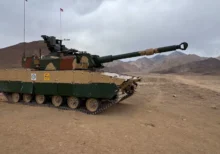
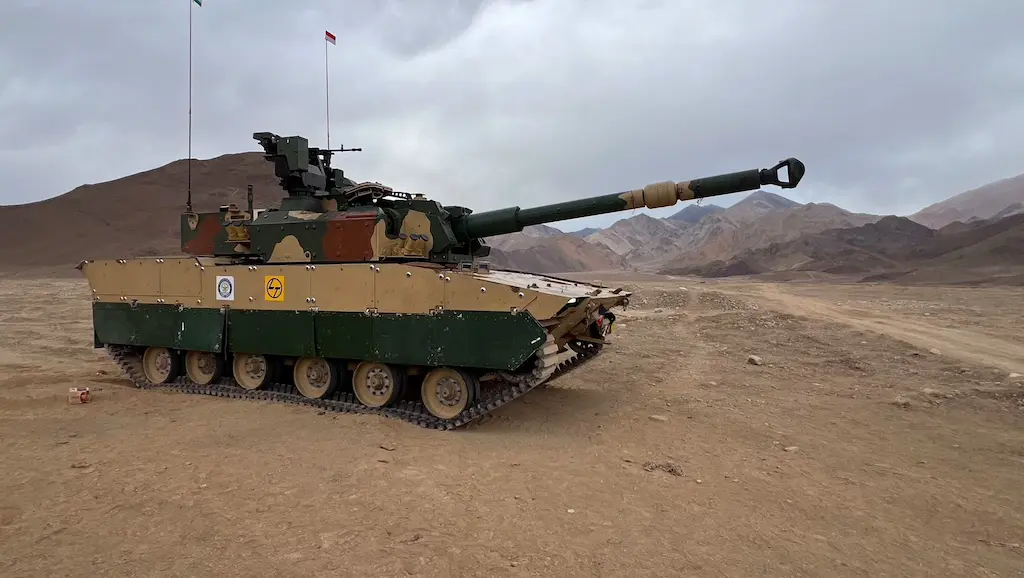
The design behind this requirement makes sense. The Zorawar prototype features a John Cockerill C3105 turret from Belgium, which has a 105mm autoloading main gun. The gun is standard for light tank engagements and is also used by the Chinese Type-15 on the other side of the Line of Actual Control (LAC).
Zorawar light tank has a 12.7mm remote weapon station on top. It also features two launchers for the Nag Mk-2 anti-tank guided missile, an advanced fire-and-forget weapon capable of striking targets at long range. It adds strong anti-tank abilities.
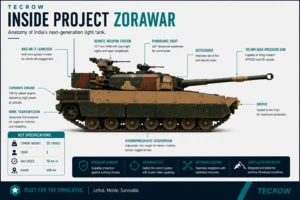
The tank is powered by a 760-horsepower Cummins Advanced Combat Engine and a RENK automatic transmission from Germany. The setup provides it a power-to-weight ratio of about 30 horsepower per tonne, making the Zorawar one of the most mobile light tanks in its class worldwide.
A weight limit of 25 tonnes is important. Tanks that weigh less than this can be transported by medium-lift aircraft such as the Embraer C-390 Millennium, which India is considering for its Air Force. If a tank weighs more than 25 tonnes, moving it becomes difficult.
It would require larger aircraft such as the C-17 Globemaster, the Il-76, or the Airbus A400M. These planes are fewer in number and are harder to deploy quickly in a crisis. For a tank designed for fast deployment in areas with limited air transport, keeping the weight under 25 tonnes is important.
What the army saw in Ukraine
The Indian Army wants more armour fitted to the Zorawar, and its desire for greater protection is not irrational. It is driven by something every serious defence analyst has been grappling with since 2022. The Ukrainian battlefield has fundamentally changed what it means for light armour to be survivable.
Vehicles considered adequately protected five years ago are being destroyed by first-person-view drones carrying repurposed rocket-propelled grenades. These weapons cost a few hundred dollars and are being manufactured by amateurs in converted workshops.
Loitering munitions find and strike from above, where armour is thinnest. Javelin-class top-attack anti-tank guided missiles are now available to both state and non-state actors in quantities that were unimaginable a decade ago. Precision artillery, guided by cheap commercial drone reconnaissance, completes the threat environment that makes the protection equation for any armoured platform far more demanding than it was when Zorawar’s requirement was written.
The Army currently is asking legitimate questions. Can Zorawar survive a 30mm infantry fighting vehicle cannon? Can it survive a drone-dropped munition? Can it withstand sufficient artillery fragment impact to allow its crew to escape? These are the right questions for a platform expected to remain relevant for 20 to 30 years.
The Chinese Type-15, which Zorawar was designed to counter, does not operate by itself. It works with attack helicopters, armed drones, loitering munitions, long-range artillery, and a wide network for intelligence, surveillance, and reconnaissance. If Zorawar cannot withstand the first attack from any part of this system, its impressive mobility won’t matter.
The current basic protection level of Zorawar, STANAG 4569 Level 4, defends against fire from 14.5 mm heavy machine guns, fragments from 155 mm artillery shells, and blasts from mines equivalent to 10 kilograms of TNT under the vehicle’s hull. Increasing it to level 5 would protect against 25 mm armour-piercing rounds.
Level 6 provides defence against 30 mm armour-piercing ammunition and almost direct hits from 155 mm artillery. There is a big gap between Level 4 and what today’s battlefield requires, and the Army needs to address it. The challenge is figuring out how to do this.
The weight cascade
Adding passive armour seems like the obvious solution. However, if we pursue this option without careful planning, we risk ruining everything Zorawar was meant to achieve.
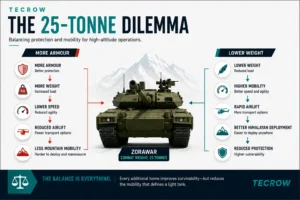
Adding more armour to a vehicle leads to many design changes. Heavier armour makes the hull heavier. A heavier hull needs more suspension travel and stronger parts. More weight in the suspension requires more engine power or results in less performance. If the engine is more powerful, it needs more fuel. More fuel adds more weight.
Upgrading the suspension affects how the vehicle behaves on soft ground. Overall, the vehicle becomes wider, taller, or longer to fit the new parts. This can also change bridge crossing limits and air transport requirements. Eventually, the vehicle may no longer meet the original requirements.
It is a real concern. The history of armoured vehicle development shows this clearly. The American M10 Booker, the British Ajax, and the German Puma infantry fighting vehicles all became heavier by the time they entered service than when their requirements were first written. It happened because new threats increased the need for better protection as development progressed.
The Puma was intended as a fast infantry carrier, but it created major logistics challenges for the units that used it. The Ajax programme took years to fix vibration and noise problems, partly due to the weight and complexity of its electronic systems and armour. Similarly, the Booker was designed as a mobile, protected firepower system for airborne and infantry units but became too heavy, hindering its intended operational flexibility.
If Zorawar follows and continues to increase its weight from 25 tonnes to 28, then to 30, and finally to 32, there will be clear effects. The option to use the C-390 for airlifting disappears. The capacity of mountain bridges limits movement. The power-to-weight ratio that makes Zorawar stand out in its class becomes normal.
At 32 tonnes, the operational case for Zorawar over a more heavily armed and protected tracked infantry fighting vehicle becomes harder to make.
A better path
The Indian Army’s concern about survivability is valid. The method of addressing it through passive armour alone is not.
Modern light armour survivability is not achieved by adding steel. It is achieved by making the vehicle harder to hit, harder to kill when hit, and capable of defeating incoming threats before they arrive. The technology to do this exists, with parts of it indigenously developed.
An Active Protection System, either the Rafael Trophy or India’s own Defence Active Protection System under development, can intercept incoming anti-tank guided missiles and rocket-propelled grenades before they reach the hull. This capability addresses the most statistically significant modern armour threat, the ATGM, without adding a single kilogram of passive armour.
Explosive Reactive Armour and Non-Explosive Reactive Armour modules are added to specific parts of a vehicle to protect against shaped-charge warheads. They are lighter than solid steel but offer similar protection. To combat the threat of drones, there is a system that combines electronic warfare, radar, and hard-kill methods.
The system is particularly important given Ukraine’s experience with FPV drones. Multispectral camouflage and thermal signature reduction help the vehicle avoid detection and targeting. A 360-degree sensor system with AI-assisted threat detection allows the crew to respond faster to threats that regular armour cannot stop, no matter how thick it is.
The layered protection approach allows Zorawar to meet the demands of the modern battlefield without the weight penalty that would destroy its operational advantage. A 25-tonne vehicle with an active protection system, reactive armour modules, and counter-drone capability is a more survivable platform against the actual 2026 threat environment than a 30-tonne vehicle with heavier passive steel, because the threats currently killing light armour are not the ones passive armour stops.
The distinction
The Zorawar programme has achieved something India’s defence procurement rarely manages. A capable indigenous prototype developed at speed, tested in the intended operational environment, and producing feedback that is actually being used to improve the design. The Nag Mk-2 integration is working. The high-altitude trials have generated actionable data. The DRDO-L&T partnership has functioned as a genuine collaboration rather than the dysfunctional contractor relationship that has plagued other Indian programmes.
All of that is worth protecting. And it is worth protecting precisely because the weight argument, if it wins, will produce a platform that the Indian Army will induct, operate for three decades, and gradually realise does not quite do what they needed it to do, the same slow realisation that followed the Ajax in Britain and the Puma in Germany.
For a tank whose justification is mobility in terrain where heavier armour cannot go, mobility is not a performance metric to be traded for survivability. It is survivability. The crew of a 25-tonne tank that can move, conceal, and reposition before it is targeted is more likely to survive than the crew of a 32-tonne tank that cannot.
The Army’s instinct to improve protection is right. The method of addressing it needs to be argued more carefully. Zorawar can be both survivable and deployable. But only if the decision about how to achieve survivability is made with as much rigour as the decision about where the tank will fight.
India spent six years developing the Zorawar to fill a gap exposed by China’s Type-15 at Galwan in 2020. The engineers got it right. The question now is whether the requirement writers will allow them to keep it that way.