Key ideas
- •Nextleap's fibre-optic kamikaze drones are immune to radio-frequency jamming, allowing them to strike targets even in heavily contested electronic warfare environments.
- •The jet-powered Stryker strike drone can reach speeds of up to 650 km/h during terminal attack, making it one of India's fastest indigenous kamikaze drones.
- •Its autonomous Sentinel system combines AI-powered surveillance drones with self-charging docking stations to provide continuous, 24/7 perimeter security.
The car was packed to the roof. Every drone Nextleap Aeronautics had built, tested, and deemed ready for demonstration was loaded into the vehicle, and Alvin Anthony, co-founder and chief executive of the Bengaluru-based aerospace startup, got behind the wheel with Thaariq Ahmad, his co-founder and chief operating officer, beside him. They had decided, within days of the Indian military’s Operation Sindoor in May, to drive, not fly, from Bengaluru to Kashmir.
“We in fact took the car, loaded up all the drones that we have, went from Bangalore until Kashmir,” Alvin says. “Demonstration at every place. Trying to understand what the army units understand, what they want, and what are the problems that they faced during operations.”
The journey covers more than 2,500 kilometres (1,550 miles) of Indian highways, military roads, and mountain approaches. At every major station along the route, they unloaded the drones and flew them. By the time they reached the northernmost stations, the war had very recently been fought on, and near the terrain they were standing on. “Every place which was attacked, we were there,” Alvin says. “And many places were like you could see the border post just with the naked eye. It was very close. Hardly less than a kilometre or something.”

Standing that close to the line, watching soldiers who had operated under conditions he had only previously understood from briefings, Alvin says something shifted in how he thought about what his company was building. “When we interacted with the users, it became very clear that we need capabilities which would basically deter the other side from even doing some sort of terrorism operations against us. The other side will think twice, three times. These guys will blow the hell out of us.”
He states this straightforwardly, not to make it more dramatic. This is not a defence contractor reading from a product brief. This is an aerospace engineer who drove to the front line with a car full of drones and came back knowing exactly what he needed to build.
The story of Nextleap Aeronautics
The R&D facility at Mahadevapura, Bengaluru, does not look like the kind of place that builds what armies want. It is a part of the broader industrial campus of a public sector undertaking, in a part of eastern Bengaluru that feels more workaday than cutting-edge.
Nextleap Aeronautics Private Limited was incorporated in 2019 and employs a team of engineers whose aerospace credentials are unusual for a startup of its size. Alvin spent years at Airbus in France and India, working on the certification of the A319, A320, A321, and A330 family of aircraft, the same class of narrow-body jets that today connect virtually every major Indian city.
Thaariq worked in Germany on engine and platform certification programmes. Both began their careers at the National Aerospace Laboratories in Bengaluru, where they first crossed paths in 2007 and 2008 working on the same aircraft programme.
“We had a vision that something of a large scale needs to be designed and developed, manufactured in India,” Alvin says, “because we as a country have the potential and capabilities, but still we are always behind the technology curve. Even compared to China on that.”

Before Nextleap was a defence company, it was almost a commercial aviation one. In 2007, Alvin and Thaariq developed, as an internal project, a design concept for a 150-seat aircraft, exactly the class that now dominates Indian aviation. “We believed that air travel would increase, and India as a country should develop its own aircraft programme,” Alvin says. “But unfortunately, our organisation didn’t have that vision to think of the future basically.”
Thaariq added, “This particular project gave us the exposure to the skills and the skill sets that are required to make an aircraft and how the whole thing comes together in even the larger perspective.” The exercise taught them aerospace systems engineering from first principles. It also left them restless.
Returning to their careers, Alvin to Airbus in France, Thaariq to Germany, they spent years inside the world’s most rigorous aircraft certification programmes before concluding, in 2018, that the next revolution in flight was electric aviation. “We decided to start Nextleap as a company which will start this electric aviation sector in India,” Alvin says.
Then COVID arrived, and the electric aviation programme stalled. But rather than close the company, they pivoted to design and manufacturing services for other drone companies. “We started offering design and manufacturing services to various drone companies, various aerospace companies,” Alvin says. “They would just come with the concept. We would go back, design it, fabricate, manufacture, and supply to them.”
It kept them alive. It also quietly built, over four years, exactly the manufacturing competence and production discipline they would need for what came next. By 2023, they decided to stop building other companies’ products and start building their own.
The first product
The first product, an agricultural drone, Nextleap certified through the Directorate General of Civil Aviation, did something the regulator had not seen before from a drone company. “Getting that certification was a very easy thing for us,” Alvin says.
“And even DGCA really appreciated the kind of documentation and the processes that we were following and how even a drone has to be designed, manufactured, and built. They had never seen that kind of thing before, because every other UAV or drone company in India was basically started by youngsters who had just come out of college. But we had the aviation experience. Real aircraft experience with safety and performance. All this basically comes into play.”
The certification gave Nextleap credibility. The defence vertical, which both founders had always intended to enter, could now be pursued. Sheikh Akhter, a former serviceman who joined Nextleap in 2024 and is now Vice President of Business Operations at the company, served as a bridge between the engineers who build these systems and the officers who use them.
“These products are not very regular products,” Akhter says. “These are developed by taking suggestions from the armed forces.” The company’s manufacturing capacity today stands at approximately 250 larger drone airframes per month and around 2,000 smaller platforms per month, all produced in Bengaluru.
Most of the supply chain has been deliberately localised. Carbon fibre parts, electronics, flight computers, navigation and guidance systems are all sourced from Bengaluru or nearby. “Even the flight computer, the navigation and guidance system is manufactured here in Karnataka, in Bangalore itself, by companies,” Alvin says.
“Whenever we are doing something, we are always thinking from a different angle,” Thaariq says. “Tomorrow, if I don’t get this [any particular equipment] from the neighbouring country, do I have a source here? And that is how we are developing the source for every project.”
The fibre optic breakthrough
The product that first brought Nextleap to the Indian Army’s serious attention was not a drone that carries grenades, or one that flies at jet speed, or one that docks autonomously on a perimeter station. It was a wire. Or rather, it was what that wire made possible.
“We were the very first company, in fact, in India to basically develop a fibre optic guided kamikaze drone,” Alvin says. The platform was called Blaze. It is now inducted into the Indian Army, and its operating principle directly addresses what Alvin describes as the fundamental challenge of modern drone warfare: the jammer.
“In a situation of war, you will have jammers everywhere. You will have active radars, passive radars, multiple of these jamming systems, which will prevent any UAV from your side from going there basically,” he explains. “Because everything is working on the RF spectrum. Even our GPS or the GNSS module, which we put on our drone, is also working on an RF spectrum.”
A conventional drone approaching an enemy jammer network will be neutralised, its link severed, its navigation denied, before it reaches its target. It is the documented experience of drone operations in Ukraine, where both sides have invested billions in radio frequency suppression.
Fibre optic guidance removes the radio frequency from the equation entirely. The drone carries a spool of fibre optic cable that pays out as it flies. Command and video signals travel through light rather than radio waves. There is nothing for a jammer to intercept, nothing for a spoofer to corrupt. “The only way of making it useless is by cutting the fibre optic cable,” Alvin says. “But in the initial days of any conflict, this would basically become a very potent tool.”
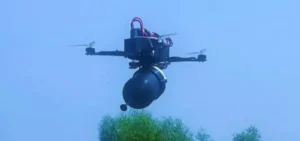
The operational logic is specifically about sequencing. “Once that opens the doorway, once a couple of jammers and radars are basically taken out, then you send all other drones,” Alvin says. “It is about punching a hole. It is not only to provide constant information. It is also about killing the jammers.”
Building this system required Nextleap to build an ecosystem that did not exist. The fibre optic cables were not imported. Nextleap approached Indian legacy cable manufacturers and convinced them to develop custom versions for drone application.
“These are not small companies,” Alvin says. “These are the legacy companies which are building, manufacturing cables for multiple use cases, multiple industries, for generations and generations. We went to them and said, this is the requirement. This probably will be the future. Why don’t you come join hands?”
The cables arrived on large drums, ten kilometres, fifteen kilometres per drum. They could not be fed directly onto the drone’s spool. So Nextleap built a machine. “We made the machine also”, Alvin says, almost as an aside. “Otherwise, the ecosystem wouldn’t work.”
A custom cable-winding machine that could transfer the raw cable from industrial drums onto the small, precise spools that fit inside the drone airframe. Then the electronics, which involve fibre optic cable that carries light, not electricity. Converting those optical signals into the copper signals a flight computer reads required working with Indian companies already producing optical-to-electrical converters for the broadband industry.
Nextleap adapted their systems for an airborne application. Everything, from the raw glass fibre to the light signal arriving at the drone’s processor, was Indian-made. Blaze was the result. It carries approximately 500 grams of explosive, modest by any conventional munition standard, but sufficient to destroy a jammer, a radar, or a vehicle. The Indian Army inducted it, and then transitioned to a larger platform as the programme matured. That platform is SkyHammer.
The SkyHammer
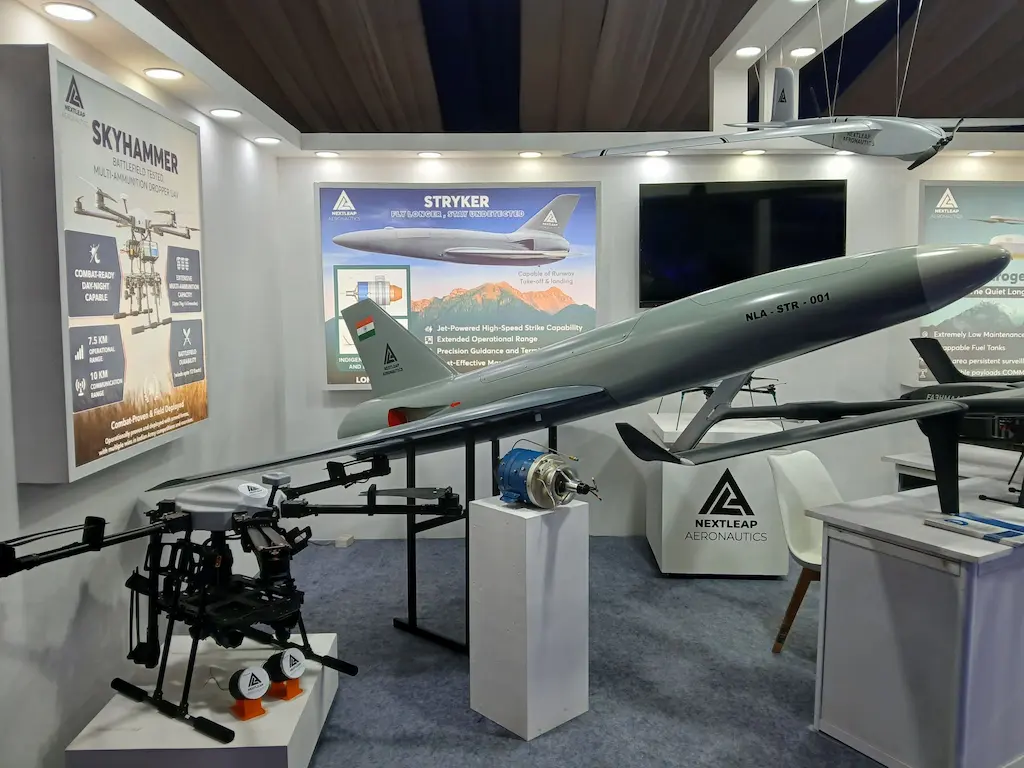
If Blaze was the pioneer, SkyHammer is the workhorse. Nextleap calls it a “battlefield-tested, multi-ammunition dropper UAV”. At a maximum take-off weight of 25 to 27 kilograms (55 to 60 pounds), with a payload capacity of up to 7 kilograms (15 pounds), enough to carry six MMHG grenades, or an equivalent load of 81mm or 51mm mortar rounds, SkyHammer represents a domestically developed weapon system actually in service with the Army.
“The brand has taken over the name of the product,” Alvin says, with something that sounds like quiet satisfaction. “Many times we have seen our users do not recognise our company; they recognise the product name. So whenever we go to military stations, when we say we are the company which has developed SkyHammer.”
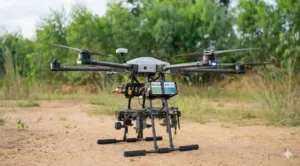
The platform operates at up to 4,000 metres (13,100 feet) above mean sea level, communicates over a 10-kilometre (6-mile) line-of-sight range, and features both day and thermal camera payloads for target identification. It is modular in its weapons configuration, “weapons agnostic,” in Alvin’s phrase.
“It can have a machine gun, it can have a grenade launcher, it can have any weapon. You want to put an ATGM on it, anti-tank guided missile, or you want to put a precision-guided missile, you can do that.”
The Army, Nextleap says, has already inducted SkyHammer. Akhter added, “Our products are much appreciated by the army, especially when we supply it. We have got a lot of commendations from the higher echelons. They have used it, and it is a trusted product.”
At this stage in most Indian defence company profiles, the conversation would pivot to plans, to aspirations, to what might be achieved if the right contracts come through. Nextleap is unusual in that the products being discussed are not future aspirations. They are current inventory.
The Sentinel
Not all of Nextleap’s portfolio is about killing. The Sentinel programme is about watching, but it illustrates an equally ambitious kind of engineering, and the problem it solves keeps senior officers awake in a different way.
“The biggest problem for them [the Indian Armed Forces] is manpower shortage,” Alvin says. He describes the Pathankot airbase attack, when armed men breached a perimeter that required constant human surveillance to secure. “Maintaining the security and surveillance of a ten to twenty kilometre perimeter base is very difficult. You can’t send soldiers everywhere every time. You need some eye in the sky which is constantly monitoring the perimeter.”
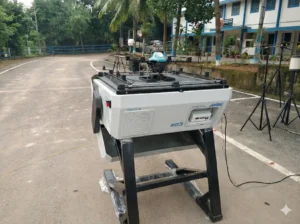
The Sentinel is a 3.15-kilogram quadcopter surveillance drone with 50 minutes of endurance, day and thermal cameras, AI-powered threat detection, and GPS-denied navigation capability. But the Sentinel alone is not the product. It is the system built around it that matters, which is India’s first all-weather autonomous UAV docking station.
“This is a docking station in which a drone is actually kept,” Alvin explains. “The user will be just one security officer inside his control room. On his monitor, he will key in the coordinates where the surveillance mission must be performed. The dock will automatically open. The drone will take off. It’ll go and perform the mission. It’ll send real-time feedback to the security officer with actionable insights if there is an activity.”
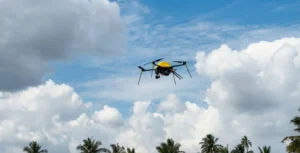
When the battery drops, the drone returns, docks, and charges automatically. Meanwhile, the second drone in the system goes up. “You have this back-to-back security and surveillance, which basically will prevent a lot of future attacks.”
The Indian Air Force is inducting this system across multiple stations. An entire command, Alvin says. The implications of that claim are significant. India has seven Air Commands, covering every strategic zone from the Andaman and Nicobar Islands to the western border with Pakistan. An induction at command level means dozens of installations receiving a technology that, until very recently, no Indian company was building.
“Within three to four months of that particular engagement, we came up with a concept, and we also developed a prototype,” Alvin says. “We took it to the end user, and today that entire system is going to get inducted in the entire command, multiple of those systems.”
Akhter contextualises it from a user’s perspective, “Since we have fought a lot of wars, now this is a complete change of course in terms of fighting the wars. The coming war will be a kind of a year-to-war, not a man-on-man war. In that, the drone, counter-drone, these will be the deciding factors for any victory or damage or whatever.”
The Stryker – One of India’s fastest kamikaze drones
The Stryker is different from everything else Nextleap has built. Different in category, different in ambition, different in what it represents for India’s indigenous strike capability. It is a jet-powered aerial target and deep-strike kamikaze platform. It weighs 140 kilograms (308 pounds), takes off from a runway, and cruises at 450 kilometres per hour (280 miles per hour). In terminal strike mode, it hits its target at 650 kilometres per hour (404 miles per hour).
To understand why that last number matters, you need to understand how the drone war has evolved. Iran’s Shahed-136 loitering munition, which has been used in enormous numbers in Ukraine and other theatres, travels at approximately 185 to 200 kilometres per hour (115 to 125 mph). Small interceptor drones, the kind that can be launched cheaply to knock down incoming kamikaze systems, typically fly at around 350 kilometres per hour (217 mph).
The Shahed, which flies slower than its interceptors, can be chased down. Iran understood this. Newer variants of long-range kamikaze drones have been pushing higher speeds. But even the most modern systems struggle to exceed 450 kilometres per hour before their propulsion systems reach their limits.
Stryker is jet-powered. “Stryker will fly at a speed of 550 kilometres per hour, which is way faster than an interceptor,” Alvin says. “And even if there is an interceptor which will have a speed similar to Stryker, 550 kilometres per hour, it will run out of juice in three to four minutes.”
The calculation is about energy. A quadcopter interceptor capable of 550 kilometres per hour burns through battery at an extraordinary rate at that speed. Sustaining the intercept long enough to actually reach and destroy a Stryker approaching at the same velocity while both are manoeuvring in three dimensions is, in Alvin’s assessment, currently beyond available interceptor technology.
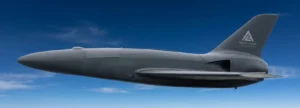
And Stryker’s strike speed climbs even higher in terminal dive. “Our drone can basically do a strike at about 650 kilometres per hour, which is, in terms of magnitude, the kinetic energy of the kill itself is huge, in addition to the things.”
What the kinetic energy argument means is that Stryker does not depend entirely on its explosive payload. A 140-kilogram object arriving at 650 kilometres per hour carries enormous destructive energy even before the warhead detonates. It is the physics of modern hypersonic weapons applied, in a more modest but practically achievable form, to an affordable unmanned platform.
The range is 300 kilometres (186 miles). That puts targets well inside enemy territory reachable from launch positions in India. The navigation is autonomous and fire-and-forget. “It is completely unguided, like a fire-and-forget system,” Alvin says. “So those are the kind of platforms that we are actually building.”
Stryker was showcased at Nordic 2026, the defence exhibition in Norway. It was there that the previous Indian Army Chief publicly endorsed the platform. “The previous Army Chief, the Army Chief, appreciated the product, saying that this is something that the country needs,” Alvin says.
The Army’s procurement intent, he says, is approximately 1,500 systems. That number, if it materialises into a formal order, would represent one of the largest single drone procurement decisions in Indian military history by unit count.
The engine
Behind every Stryker is a problem that India has never solved at scale, the engine. India designs and manufactures aircraft. It does not, with any consistency, design and manufacture the engines that power them.
India relies heavily on imported engines for its defence, including Russian turbofans and American turboprops, which is a major weakness in its defence industry. If the country builds a jet-powered strike drone but still uses foreign jet engines, it will create the same weakness on a smaller scale.
Nextleap identified this before they built the airframe. “Before we developed the Striker, we had the jet engine ready,” Thaariq says. This is the opposite of how most programmes work. “The jet engine development started before the development of the actual UAV. Now it is like that because that takes a longer time than the aircraft, typically.”
The engine partner is a Bengaluru company called DIA Engineering. “They are doing the jet engines for us, which was again showcased in our Nordic 2026 presence,” Alvin confirms. “This is the first time a jet engine has been developed; it’s undergoing testing at this point, which will then eventually get mounted on the platform.”
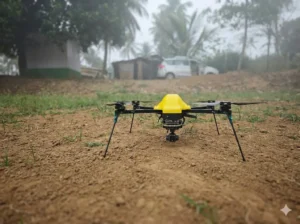
Thaariq elaborates on the engineering challenge. “Micro gas turbines are running at one lakh revolutions per minute (RPM).” For context, a typical car engine peaks at around 6,000-7,000 RPM. A micro gas turbine at 1,00,000 RPM requires materials, tolerances, and bearing technology that are genuinely demanding manufacturing problems. “This is not a simple thing. It’s a very powerful system.”
The future roadmap extends further. “We are working on a small internal combustion engine for a drone, which will in the future lead to a bigger product engine,” Thaariq says. “It’s an engine similar to what is being used in the Shahed drones. What we are doing is right now miniaturising that engine, and this engine development is basically happening in-house. It’s not outsourced because the engine technology is crucial. We want to keep that in-house.”
The ambition is total propulsion sovereignty not just for Stryker, but for everything that follows it. “For the future, we are self-sufficient in all, not just in terms of the whole thing, but the power plant, the communication system, the payloads, all of these will have to,” Thaariq says. “Because now we are looking at electronic warfare probe drones, anti-channel drones. These things have to be done.”
The laser question
Akhter, who spent decades in the Indian Armed Forces before joining Nextleap, is direct on the question of how drones can be saved from laser weapons, suggesting this is not idle speculation. “There is some technology that is underway,” he says. “There is some coating coming out. The melting point is somewhere 3,500 degrees. 3,500 degrees.” He lets that sit. “Now normally a laser comes with 1,000 degrees. So that will be coated on the UAVs.”
He adds that the motor components and flight controllers remain vulnerable through other mechanisms, but for directed energy in its current form, the coating is the answer. He declines to name the institution developing this coating, though he confirms research is active and that multiple organisations are involved.
The connection to a national research organisation is strongly implied. And the technical claim, an ablative or thermal barrier coating rated to 3,500 degrees Celsius against a laser weapon operating at approximately 1,000 degrees, is consistent with what materials science has achieved in ultra-high temperature ceramic compounds, as Tecrow has previously reported.
If this coating reaches production-ready form and is applied to platforms like Stryker, it significantly complicates the engagement calculus of directed energy systems being developed across the Indo-Pacific.
Alvin adds his own perspective, “For every threat or counter-threat which eventually will be developed, it will be envisioned. Of course, lasers are still coming up, so we know that they will eventually be a threat. And by the time we will have something which will be basically countering the lasers for sure.”
The engineering philosophy underneath this is consistent across everything Nextleap builds. “Whatever system that we are talking about today,” Thaariq says, “in a few months from now, that is going to be obsolete completely. It will be completely different. So unless we have a hold on the technology side and understand the basics of both systems, we cannot advance. We will have to be constantly advancing, trying out new things, trying out new ways, out-of-the-box thinking.”
What’s next
The machine gun drone is not yet in service. But it is under trial with a named defence agency, which Nextleap declines to specify. A UAV carrying a machine gun, capable of engaging both aerial threats and ground targets, represents the next step in the weaponised vertical. After the machine-gun variant, Alvin mentions a system designed for electronic warfare, probe drones that can carry electronic-warfare payloads rather than kinetic ones. After that, anti-drone systems.
The company is also preparing for export. “We are exploring this year for sure,” Alvin says. “One or two of the products we believe are definitely going to have significant export potential.”
He names tier two and tier three countries as the initial target market, the class of nations that cannot access American or European drone technology at practical price points, and that are currently purchasing whatever China, Turkey, or Iran will sell them. “Irrespective of anywhere in the world, we are targeting that. These cases are similar everywhere.”
The goal is to become India’s Bayraktar. “I take a lot of great learning from Turkey,” Alvin says. “A small company called Bayraktar, when it started, they were just making some hand-launched fixed-wing UAVs. From there, they are basically a global superpower today. They have even far exceeded the US, or the European Israelis and everybody.” The comparison is not casual.
Bayraktar TB2 began as a small platform for the Turkish military, was produced in quantities that drove down unit costs, proved itself in actual combat in Libya and Ukraine and Nagorno-Karabakh, and within a decade was being exported to more than two dozen countries. The company that made it, Baykar, now employs thousands and is developing a fifth-generation drone.
Nextleap is not Baykar yet. But “we, as a team, believe in working very closely with the users,” Alvin says. “It’s not that we are building something and then going to the user saying ‘I built this, you take this.’ That’s not what we are doing. Every one or two months, we basically go to the user location. We travel, we meet them, understand what the new development is, how our previous products are functioning, what kind of requirements they are looking for.”
Akhter frames it from the serviceman’s perspective, “Being a serviceman, I have seen since the 1990s we were actually trained on Russian products. Most Russian products used to come to India, and we also had Israeli products. Now, these products were very expensive and very tough to use because of the language and other things written in Russian everywhere. This has to be phased out. That is what the Army, Air Force, and this government are looking for. Let’s make an Indian product that’s easy to handle from a user perspective and delivers the same results we expect in those countries. Easier to maintain, easier for the supply chain.”
Two engineers, one dream
The drive back from Kashmir must have felt different from the drive up. Alvin and Thaariq had left Bengaluru uncertain whether the military’s enthusiasm for their demonstrations would translate into something durable. However, they returned with more clarity, not just about what the Indian Army wanted, but about what Nextleap needed to become to provide it.
Two products are already inducted. Two more are in advanced stages of trial. Stryker, the fastest Indian strike drone in development, is approaching procurement discussions for 1,500 units. A jet engine is being tested at 1,00,000 RPM in a Bengaluru workshop. A machine gun drone is under trial, and an electronic warfare drone is in concept development.
The company that built all of this started in 2019 making agricultural drones to survive COVID, produced its first certified drone product in 2023, entered defence in 2024, drove to Kashmir in 2025, and is now planning its first exports in 2026.
“Our goal as a company is to basically become that global superpower when it comes to supplying this,” Alvin says. India’s fastest strike drone is being built in a Bengaluru industrial estate by two engineers who started at a government aerospace laboratory, went to France and Germany to learn how aircraft are certified, came back, and decided to build something the country needs and the Indian Army has noticed.