Key ideas
- •The US Marine Corps has restored medium-range air defense after a 24-year gap by deploying the MRIC system to Okinawa.
- •MRIC combines Israeli Tamir interceptors with American radar and command systems to defend Marine Littoral Regiments from cruise missiles and drones.
- •Together with NMESIS and MADIS, MRIC completes the Marine Corps' new layered island-defense strategy across the Indo-Pacific.
In 2002, the US Marine Corps retired the MIM-23 Hawk missile system. The Hawk was a Cold War platform designed to shoot down Soviet aircraft over a European battlefield that no longer existed. The Corps decided it no longer needed organic medium-range air defense in the large-scale amphibious operations the Marines were built for.
That reasoning made sense for a force designed to storm beaches and hold ground. It made less sense for the force the Marine Corps was becoming. For 24 years, Marines operating in the Pacific had nothing between a Stinger shoulder-fired missile with a range of roughly 5 kilometers and Patriot systems, which required heavy infrastructure and belonged to a different service entirely.
On a small island in the southern Ryukyus or the northern Philippines, exactly where the new Marine concept places its units, Patriot was not an option. That gap existed across two and a half decades of Pacific deployments. Last week the service started closing.
On June 28, the US Marine Corps announced that the Medium-Range Intercept Capability (MRIC) is now part of the III Marine Expeditionary Force (MEF), the only MEF currently deployed forward in the US military and is based in Okinawa. The system was tested on June 22 at Mason Range in Guam during the Valiant Shield 2026 exercise.
“Our modernization efforts and forward posture send a clear message to the region,” III MEF Commanding General Lieutenant General Roger Turner said in the announcement. “By enhancing our defensive capabilities with the MRIC, we are strengthening our ability to stand with our allies and partners.”
What is MRIC
The MRIC, popularly known as the Iron Dome, is a US-designed mobile air defense package built around one proven Israeli component, integrated with American radar and command-and-control systems into something the Marine Corps has never had before.
The interceptor it uses is the Tamir missile, the same round Israel fires from Iron Dome batteries to defend its cities against rockets and cruise missiles. It is a battle-tested weapon with thousands of operational intercepts to its credit. But the Tamir alone is a missile looking for a system to fire it, and MRIC provides that system.
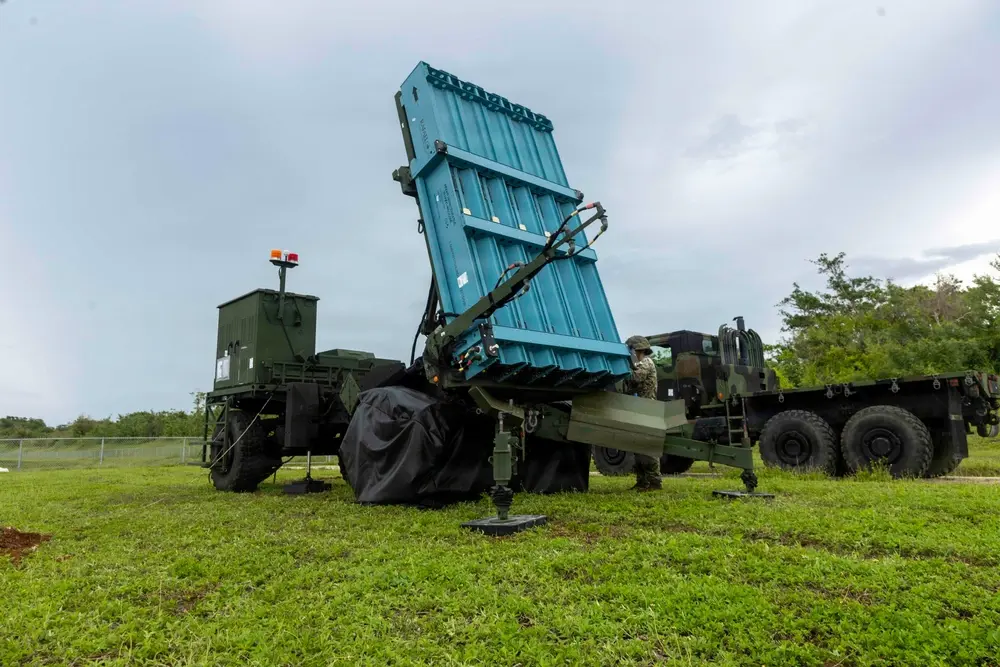
The launcher is a pair of Joint Light Tactical Vehicles, the same truck the Marine Corps uses across most of its ground operations. One carries detection equipment; the other carries the interceptors. The vehicles are connected to the AN/TPS-80 Ground/Air Task-Oriented Radar, known as G/ATOR, a Northrop Grumman system built on a gallium nitride active electronically scanned array that provides 360-degree surveillance and can generate fire-control-quality tracks in a single scan.
G/ATOR detects and classifies cruise missiles, unmanned aircraft, manned aircraft, and ballistic missiles simultaneously across its coverage cone. The tracking data is fed to the Tamir launcher via the Common Aviation Command and Control System. Each trailer carries twenty interceptors. The engagement envelope ranges from approximately 3 to 70 kilometers.
The result is a system two soldiers can operate from a pair of vehicles, set up rapidly on a small island with no permanent infrastructure, that can engage aerial threats the Stinger cannot reach and does not require the logistics chain that Patriot demands. It can be driven off a ship, moved to a new position overnight, and set up again before dawn.
Force Design 2030
To understand why MRIC matters specifically in Okinawa, it is necessary to understand what the Marine Corps has been trying to become over the past several years.
Force Design 2030 is the transformation of the Marine Corps from a force built around large amphibious assault brigades into one built around Marine Littoral Regiments, small, distributed units operating across chains of islands, using the geography of the western Pacific as both terrain and weapon.
The logic is that the island chains stretching from Japan through the Philippines toward Taiwan create natural chokepoints through which Chinese naval forces must pass in any westward or southward operation. A Marine Littoral Regiment positioned on an island in that chain, armed with the right weapons, can threaten every Chinese vessel within hundreds of kilometers.
That weapon is NMESIS, the Navy-Marine Expeditionary Ship Interdiction System, Naval Strike Missiles mounted on Joint Light Tactical Vehicles, capable of engaging surface targets at ranges exceeding 180 kilometers from a ground launch position. NMESIS gives a small Marine unit the ability to create a maritime denial zone larger than many European countries, fired from terrain that Chinese ships cannot easily approach without being targeted first.
The problem Force Design 2030 created with NMESIS is the same problem it solved with the island concept. A unit valuable enough to threaten Chinese naval access through island chains is worth targeting. Chinese cruise missiles, drones, and aircraft are the obvious response to Marines holding islands with anti-ship weapons. Before MRIC, those threats had a wide-open answer against the dispersed island forces. The Marines could not stop them with organic weapons at meaningful range.
MRIC closes that equation. An island position now holds NMESIS to threaten ships and MRIC to defend against the cruise missiles and aircraft that would threaten the NMESIS crews. The island becomes a kill zone in both directions simultaneously, lethal to vessels approaching by sea but survivable against attacks from the air. That combination is what Force Design 2030 required
The third layer
MRIC arrived in Okinawa alongside two other systems being simultaneously fielded, and together they tell the full story of what the Marine Corps is building.
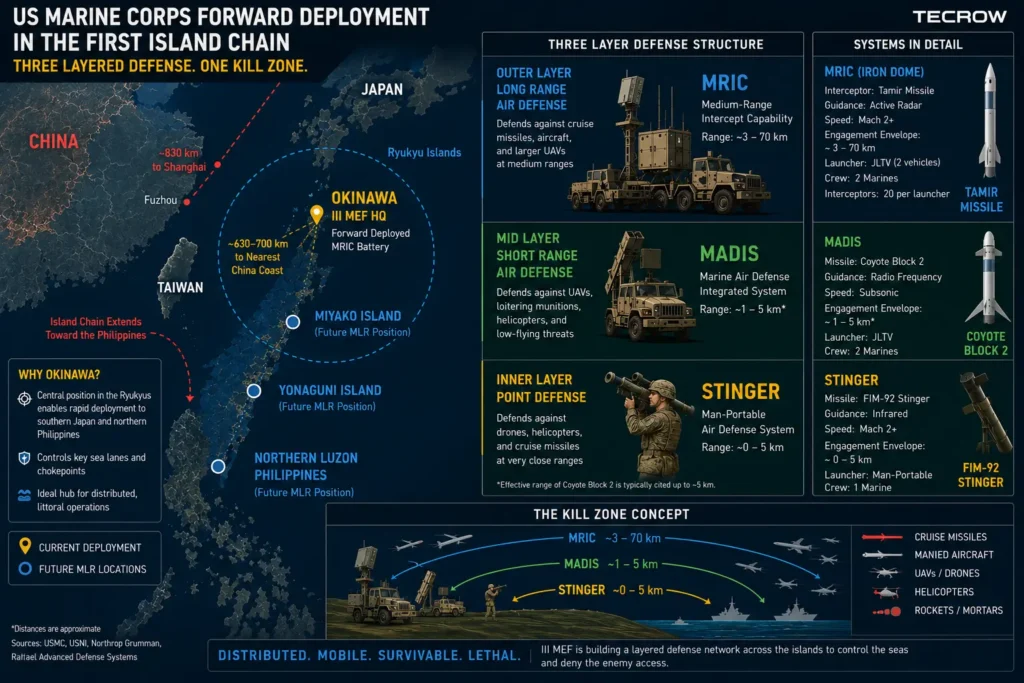
NMESIS handles the maritime denial mission, ship-killing at range. MRIC handles the medium-altitude aerial threat, cruise missiles, and aircraft at ranges of 3 to 70 kilometers. MADIS, the Marine Air Defense Integrated System, already deployed in exercises across Japan and the Philippines, handles the close-range, low-altitude threat posed by quadcopters, commercial drones, and other small unmanned aircraft that fly below MRIC’s effective engagement altitude.
Three systems cover three distinct threat categories, all launchable from light tactical vehicles, all operable without fixed infrastructure, and all deployable on islands that could not support a Patriot battery or a permanent air defense installation.
The Marine Littoral Regiment standing up on a small Pacific island in 2026 has a layered defense that covers it from drone-scale threats at close range to cruise missiles at medium range to ships at sea, with organic capabilities that did not exist as a complete package a year ago.
The signal the Marine Corps sent by deploying all three systems simultaneously, during the same exercise cycle, in front of the Indo-Pacific Command’s most senior officer, was not subtle. The islands are defended now in a way they were not before.
Arkansas and the supply chain
One detail in MRIC’s development carries implications beyond the Pacific deployment itself. Rafael of Israel produces the Tamir interceptor. RTX, formerly Raytheon, and Rafael have established a joint venture, Raytheon-Rafael Protection Systems, to build a dedicated Tamir production facility in East Camden, Arkansas.
In November 2025, RTX confirmed that it would begin producing Tamir missiles for Israel’s Iron Dome and SkyHunter interceptors for the Marine Corps MRIC program. This production will be supported by a $33 million investment and a $1.25 billion contract for Tamir missiles.
A program official confirmed in April 2026 that the US will begin producing the Tamir interceptor within the next 12 months. The Tamir interceptor, which has been used and tested in combat by Israel, will now be produced in the United States. This means technology is moving from Israel to America, which is unusual.
Israel provides design and manufacturing expertise and a strong track record of successful operations. The United States enables large-scale production and ensures supply chain security through domestic manufacturing. When the next conflict in the Pacific demands interceptors that exceed Israel’s production capacity, the Marines will not have to wait for shipments from a country focused on its own security needs.
The FY2027 defense budget includes $233.6 million for MRIC, with $157.6 million intended to procure 16 additional launchers and 410 missiles to support the rapid fielding of a single complete battery. The Marine Corps plans to have three fully equipped MRIC batteries by 2028. Two years from now, three island defense packages will exist, each with partial capability today.
What the gap looked like
For 24 years between the Hawk’s retirement and MRIC’s arrival, the Marine Corps operated in the Pacific with a specific, documented vulnerability. The old assumption, that Army air defense assets would eventually be available, was built for a different operational model. Large amphibious task forces with logistics chains reaching back to established bases had reasonable access to Patriot coverage.
A Marine Littoral Regiment on a small island, 200 kilometers from the nearest major American base, operated below the infrastructure level needed for the Patriot system. China’s cruise missile stock is large and varied, designed for scenarios in island chains. Its military and dual-use drone programs provide both quantity and endurance. The islands in the first island chain, which are key to Force Design 2030, are well within the reach of this missile inventory.
The gap in Marine air defense coverage over the past two decades was one a Pacific adversary could read in the same force design documents available to American defense analysts. MRIC does not close every gap. It does not counter the DF-17 hypersonic glide vehicle, which operates at altitudes between THAAD and Patriot. That remains a separate challenge, as detailed in the following coverage of the Chinese system’s first public launch footage in June.
MRIC addresses the cruise missile and drone threat that would accompany any pressure campaign against islands holding ship-killing Marine units. It addresses the gap on the specific islands where Marines have been stationed for 24 years.