Key ideas
- •Dubai's $35 billion Al Maktoum Airport will use AI, biometrics, and automation to eventually handle up to 260 million passengers annually, making it one of aviation's biggest infrastructure projects.
- •Repeated Middle East airspace closures and rerouted flights are exposing the risks of a global aviation network that relies heavily on Gulf mega-hubs.
- •The airport's long-term success depends not just on cutting-edge technology but also on stable regional airspace and uninterrupted global transit routes.
July is one of the busiest travel months at Dubai International Airport. On peak days, more than 225,000 passengers move through its terminals in a single 24-hour period. Nearly half of them are not going to Dubai but are taking connecting flights to Mumbai, Bangkok, Johannesburg, Sydney, London, New York, Istanbul, and so on.
Dubai is the midpoint of nearly half of the world’s passengers’ journeys and is where the world’s aviation network funnels the largest volume of long-haul transit traffic. In 2025, Dubai International Airport handled 95.2 million passengers, and it is targeting 99.5 million this year. It is operating at physical capacity and planning a $35 billion expansion at Al Maktoum to handle 150 million more.
On July 18, Kuwait closed its airspace due to missile and drone attacks from Iran on US military bases. As a result, Kuwait International Airport temporarily stopped all take-offs and landings. The closure will remain in effect until at least August 4, so no flights can pass through Kuwaiti airspace during this time.
Mabiya Kadaba, an office bearer for the Kuwait Kerala Muslim Association (KKMA), told Tecrow that the ban applies to aircraft passing through Kuwait’s airspace without landing. But, “local airlines such as Kuwait Airways and Jazeera Airways are operating,” he added. However, Kuwait Airways has announced rescheduling of some services, while Jazeera Airways issued a travel advisory citing intermittent closures.
It is not the first time airspace has been closed. The US-Iran conflict started on February 28 when American and Israeli strikes hit Iran, which led to airspace closures over Iran, Iraq, Kuwait, the UAE, Lebanon, Bahrain, and Jordan at the same time.
In the first week of the conflict, more than 23,000 flights were cancelled, and airlines lost nearly $1 billion in revenue over the first three weeks, a critical time for a region that handles millions of passengers every year. The conflict entered a period of partial ceasefire. However, on July 7, US strikes on Iranian military targets near the Strait of Hormuz resumed, prompting Iran to respond. As a result, Kuwait’s airspace was closed again.
The architectural problem
The Gulf mega-hub model developed due to a mix of geography and ambition. The Arabian Peninsula is situated in the middle of the world’s largest aviation markets, making it accessible to two-thirds of the global population within eight hours.
It lies between major demand centres in Europe, South Asia, Southeast Asia, East Africa, and the Americas. Dubai, Abu Dhabi, and Doha took advantage of this central location by building large airports and strong airlines, creating a hub-and-spoke system that allows passengers from anywhere to travel efficiently with just one connection.
It worked, as transfer passengers make up nearly half of all traffic at Dubai International Airport. In 2025, the airport served 95.2 million passengers and aims for 99.5 million in 2026. Emirates flies to 137 destinations in 72 countries, and Etihad connects Abu Dhabi to over 70 destinations.
Qatar Airways operates from Doha’s Hamad International Airport and has a similar network. Together, these three Gulf mega-hubs handle most long-haul transit passengers between Europe, South Asia, Southeast Asia, and East Africa. These routes need a midpoint hub, and the Gulf’s location makes it the best choice.
The current situation is not what the existing architecture was designed for. On July 7, the US resumed strikes on Iranian military targets near the Strait of Hormuz. In response, Iran launched missile and drone attacks on US military bases in Bahrain and Kuwait.
The Gulf mega-hubs are within the range of Iranian ballistic missiles, and Kuwait International Airport was closed due to safety concerns. But what happens if Dubai closes? There is no easy answer because the global aviation system relies heavily on Dubai, which is no longer consistently safe for operations.
The routing compression
When several Flight Information Regions close at the same time, there are only two main routes left. The primary routes between Europe and Asia are through Egypt, Saudi Arabia, and Oman/UAE, or north through the Caucasus and Afghanistan.
Neither route is a true substitute. The southern route through Egypt, Saudi Arabia, and Oman requires planes to fly through airspace that is currently open but still close to the conflict zone. Saudi Arabia borders Yemen, where Houthi drone and missile operations targeting the Gulf have been happening for years.
Egypt’s airspace is open, but its air traffic control can’t handle the extra planes that a full closure of the Gulf would create. The northern route through the Caucasus and Afghanistan adds between one and three hours to most flights from Asia to Europe, depending on where they start and end. It increases fuel costs, disrupts schedules, and worsens the passenger experience for every flight that takes this longer path.
Kuwait has extended its airspace restrictions until at least August 4. Flights passing through the OKAC/Kuwait FIR are still not allowed, except for those arriving in or leaving Kuwait with prior approval. It creates a gap in the air traffic routing in the Gulf. The gap affects not just flights to Kuwait, but also forces all planes travelling east or west in the Gulf to navigate around it. This increases the traffic in narrower routes and adds to the workload for air traffic control in nearby areas.
Airlines are making changes, but these changes come with costs. KLM has updated its flight schedule in the Middle East and continues to avoid flying over Iran, Iraq, and Israel, as well as some areas of the Arabian Gulf.
Flights to and from Riyadh, Dammam, and Dubai are suspended until August 9. Air France has restarted flights to Dubai, Tel Aviv, and Riyadh, but flights to Beirut, which were set to resume on July 20, are now suspended until August 2. Air Astana has stopped its flights to the UAE. Singapore Airlines has also extended its flight suspensions.
The India dimension
The India-Gulf air corridor is one of the busiest flight routes in the world. India has about 8.5 million workers in Gulf countries. The flow of money, family visits, and movement of workers between India and the Gulf support both India’s economy and the Gulf’s construction and service industries. This air connection is currently facing ongoing disruptions.
Air India, Air India Express, IndiGo, and SpiceJet all frequently fly to Dubai. On July 16, IndiGo’s flight 6E1235 from Hyderabad to Kuwait was delayed at Kuwait International Airport. It shows how disruptions can heavily affect Indian passengers and workers. When Kuwait’s airspace closes, it affects IndiGo flights from Hyderabad, just as it does for a KLM flight from Amsterdam.
The disruption in aviation is worsening the energy crisis. Tecrow has reported on the Hormuz crisis and its impact on LNG pricing in Asia. Countries in Southeast Asia are turning to nuclear energy as they realise their vulnerability in relying on energy from the Middle East.
The current conflict is also showing weaknesses in aviation infrastructure. The Strait of Hormuz and the Gulf’s air traffic regions are closely linked. When one is affected, it impacts the other, which in turn harms economies, like India’s, that rely on both energy imports from and labour exports to the Gulf.
The expansion and tech
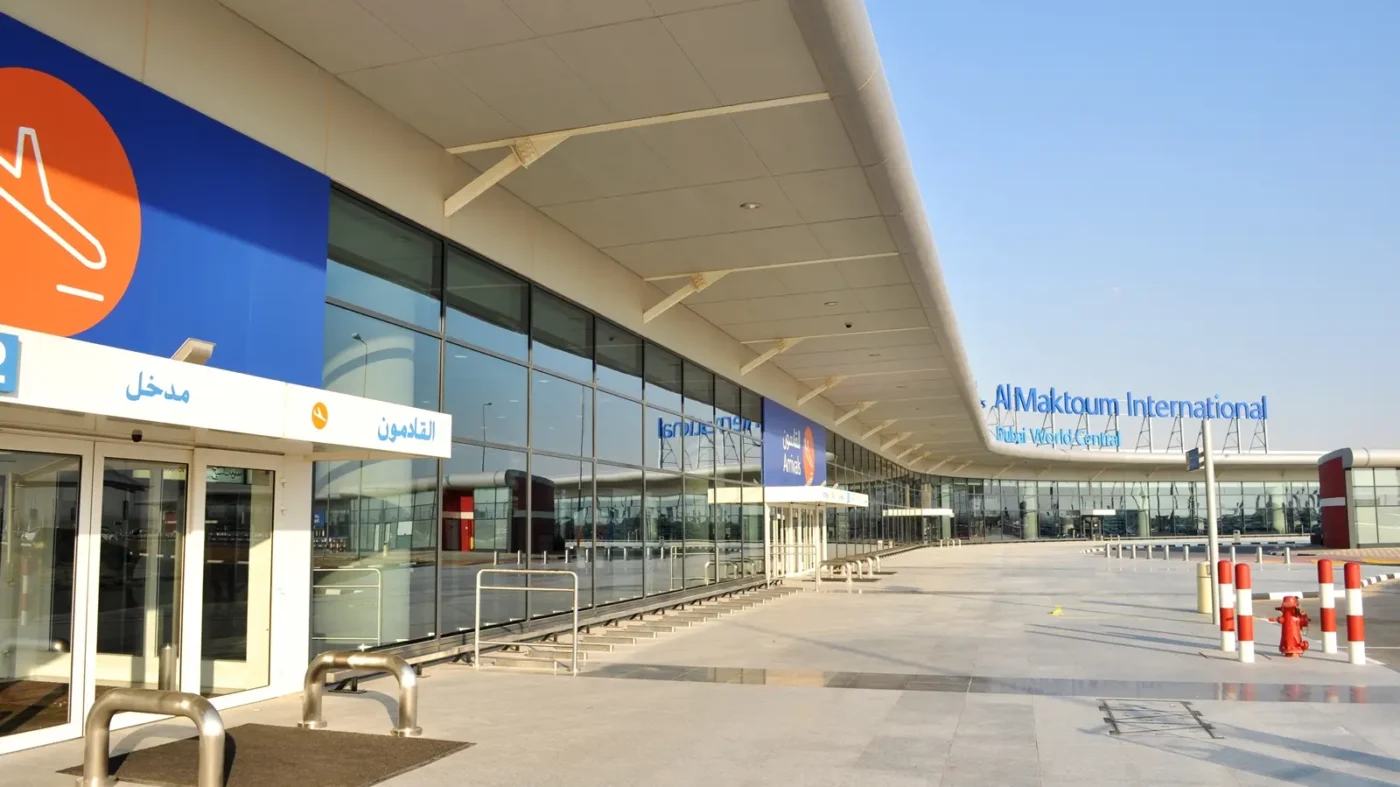
Dubai is expanding Al Maktoum Airport with a $35 billion project to enable the airport to handle 150 million passengers annually, eventually increasing capacity to 260 million. It makes it one of the largest investments in aviation infrastructure ever.
Al Maktoum’s technology architecture aims to automate as much of the passenger experience as possible, using the best available engineering. The terminal, designed by the Austrian firm Coop Himmelb(l)au, features futuristic, curved roofs inspired by desert dunes and includes large indoor green spaces throughout.
The design is a change from the simple and practical infrastructure seen in older mega-airports. However, the more important aspect is the operational technology that supports it. The airport will have a fully automated baggage handling system that can process 30,000 bags per hour via an underground network operating without human intervention at the main handling level.
Passengers will not need to show physical documents during their journey. Instead, they will use facial recognition and biometric data for identification at check-in, security, and boarding, with AI managing security screening and replacing manual inspections. Recently, Dubai Aviation Engineering Projects selected a team comprising India’s Larsen & Toubro and Japan’s Mitsubishi to build the airport’s Automated People Mover.
This transit system will run underground and connect terminals to concourses across 14 stations, with four stations set to open in the first phase. The airport is also upgrading its air traffic management, which will use a new system that enables more precise runway operations, allowing more flights to land and take off efficiently.
However, the investment relies on open airspace, clear transit routes, and no military conflicts that could disrupt airport operations. Since the conflict started on February 28, all three conditions have been tested, and not all have remained intact.
The airports are open and running. Dubai International is still operating, and Emirates has not stopped its flights. This is good news compared to the worst-case scenario. However, nearby airspace has closed, and flight routes have become limited.
Airlines have been facing rising costs for the past five months, and the situation that led to Kuwait’s closure yesterday remains serious. Iranian missiles can reach military sites in the Gulf. The difference between military and civilian targets is based on intent, not distance.
The terminal
Passengers travelling through Dubai’s Terminal 3, connecting from London to Singapore, Lagos to Mumbai, and Johannesburg to Seoul, are in an airport built on the assumption that the region would be stable. The idea has always been somewhat hopeful. The Gulf has faced conflict for the past forty years.
However, the size of the airport’s hub-and-spoke system has grown so much that any disruption is no longer just a local issue. It now impacts global air travel. Airlines have lost $1 billion in the first three weeks of the conflict. It is just a small part of the overall costs, which are now much higher after five months.
Expenses include rerouting flights, schedule changes, and passengers choosing not to fly or opting for connections through Istanbul or Singapore. Additionally, the Gulf states have lost revenue from tourism and business travel. The total impact is much larger than any current estimates.
Travellers from North America, Europe, and Asia are changing their travel plans due to heightened tensions between the United States and Iran. Many are looking for different routes to avoid potential issues. They are paying attention to travel advisories, airline updates, and discussions among fellow travellers. Some are considering connecting through Gulf airports, while others are choosing routes through Turkey, southern Europe, or Central Asia.
The initial behaviour change is small. However, if the conflict continues and Gulf airspace remains unstable through the second half of 2026, this change will increase. Airlines and corporate travel managers make routing decisions based on three- to six-month periods.
If Gulf airspace stays unstable in mid-2026, it will affect booking patterns and network decisions into 2027. It will also influence investments in airport development and the hub-and-spoke systems that airlines choose to strengthen. Dubai plans to accommodate 260 million passengers; however, the current conflict is testing whether the area’s stability, which supported this goal, is as secure as the business plan suggested.