Key ideas
- •Saudi Arabia, Türkiye and Pakistan are building a new defence network.
- •The pact could grow into a regional defence-industrial ecosystem.
- •India’s focus should be capability, especially across the Indian Ocean.
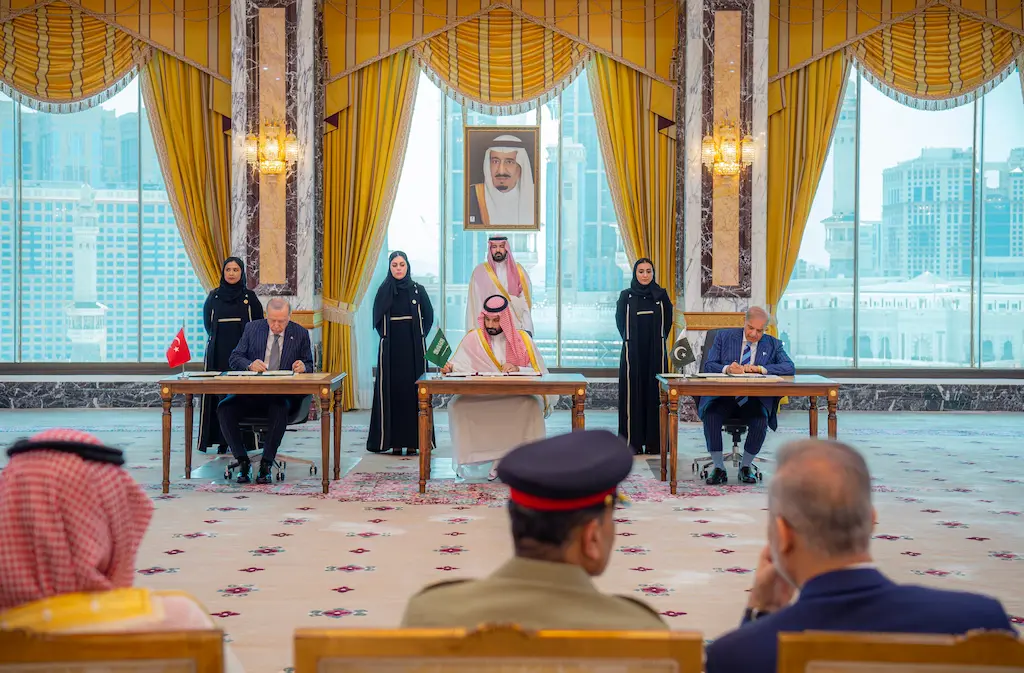
On August 7, Saudi Arabia, Turkey, and Pakistan signed the Makkah Joint Defence Agreement. The agreement states that an attack on one country will be treated as an attack on all three. The term “Islamic NATO” was used soon after, but it’s not the right way to frame this agreement and may lead India to misunderstand its significance.
Unlike NATO, the Makkah Pact lacks a unified command structure or a long history of collaboration. However, it is still important. The pact includes plans for joint exercises, political and military coordination, and cooperation in areas such as unmanned systems, electronic warfare, artificial intelligence, and defence production. It lays the groundwork for a strategic network being built over time.
Each country in the pact contributes something. Saudi Arabia could provide financial resources and energy influence, while Turkey has built a strong defence industry and exports drones, missiles, and naval systems. Pakistan contributes a large military force, counterinsurgency experience, and nuclear deterrence. Together, their strengths and weaknesses create a strong combination.
What makes this alliance even more interesting is Pakistan’s relationship with China. Chinese military technology already supports Pakistan’s aircraft, missiles, navy, air defence systems, and drones. The Makkah Pact could add to this by combining Chinese systems with Turkish technology and Pakistani military experience, supported by Saudi funding. Individually, these elements do not pose a significant threat to India, but together they could create a stronger security situation for Pakistan, which India should consider.
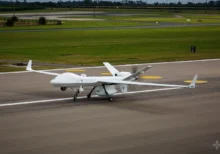
India should focus closely on Turkey in this agreement. Turkey has built a defence industry that sells products to many countries and tests them in active conflict. The Bayraktar TB2 drone, used in places like Ukraine and Libya, has shown that low-cost drones can significantly impact warfare outcomes.
The Makkah Pact emphasises unmanned systems, electronic warfare, and artificial intelligence, showing where Turkey believes future military advantages will lie. Modern warfare isn’t just about having the most expensive aircraft; it increasingly depends on who can design, build, and quickly produce drones, sensors, and munitions. Turkey can accomplish this; Pakistan and Saudi Arabia cannot yet. This raises the question of whether this partnership can help all three countries achieve goals they cannot meet individually.
The most important aspect of the Makkah Pact may not be the collective defence clause, but what these countries can build together. Combining Saudi financial resources, Turkish technology, and Pakistani military infrastructure could create a regional defence ecosystem.
Recent warfare shows that the ability to produce and maintain equipment like drones, ammunition, and sensors can decide how effectively forces operate in the field. India needs to focus on capability development rather than alliances alone.
Geography supports this point. Turkey connects to the Middle East, which then links to Saudi Arabia and the Gulf, eventually reaching Pakistan. These connections represent a physical path for technology, money, military logistics, and cooperation. India sits at the centre of this geography. The Gulf is not far away; it is vital for India’s energy supply, where many Indians live and work, and through which India’s maritime trade flows. Any major changes in the security setup in this region will affect India, whether or not India views it as a neighbouring issue.
The Houthi attacks on Saudi Arabia have tested the new defence agreement, and the response has been telling. Saudi Arabia has faced real missile and drone threats. Initially, Pakistan said that if these attacks or any spillover into Saudi territory continued, the defence agreement could be activated. However, they later clarified that there had been no discussion about a joint military response.
Collective defence and collective war are different. The Makkah framework is still working on the consultation processes and institutional practices that would turn the agreement into effective coordination. The response to the situation has been cautious solidarity, which shows us something important.
India should stop asking whether soldiers from Saudi Arabia or Turkey will join Indian forces in a future conflict with Pakistan. They are unlikely to, and this situation does not depend on the wording of any agreement. Saudi Arabia has strong economic ties with India, Turkey is far from South Asia, and both countries would face serious consequences if they committed to such action.
The better question is how much stronger Pakistan becomes with more strategic partners. Pakistan already has China as an ally and now has a formal defence agreement with Saudi Arabia and Turkey. If this cooperation grows in areas like unmanned systems, electronic warfare, artificial intelligence, intelligence sharing, and logistics coordination, Pakistan becomes harder to isolate in any crisis without Turkish or Saudi military involvement.
The pact’s real importance lies in its role in India’s challenge. India should avoid creating an opposing alliance. Its strength comes from building multiple partnerships instead of relying on just one. India should strengthen ties with Saudi Arabia, the UAE, and Oman. These relationships offer valuable support as security situations change.
India should continue to engage with Turkey despite their political differences. Cutting ties with Turkey will not stop its relationship with Pakistan. At the same time, India should maintain its relationships with Iran, Israel, the US, France, and Russia. The current international landscape is about building strategic networks instead of strict alliances.
India should focus on the Indian Ocean region. The Makkah Pact increases the Arabian Sea’s importance. India needs to enhance its capabilities in maritime awareness, long-endurance surveillance, unmanned maritime systems, electronic warfare, and intelligence fusion. These skills will determine whether India shapes events in its own region or merely responds to them. India’s position in the Indian Ocean is an advantage that no distant agreement can undermine. The key is whether India invests in making this geographical advantage meaningful for its defence.
The world is not returning to the old Cold War alliances. Countries want the ability to choose their partners freely. For example, Saudi Arabia can build a strong relationship with Pakistan while also having important economic ties with India. Turkey can stay in NATO while going after its own regional interests. India can work with the US, France, Israel, Russia, Iran, and Gulf states without being locked into one relationship. It shows the reality of today’s global order.
The Makkah Pact should be seen as a developing strategic network. Its significance will depend on what the member countries build together. The real question for India is not whether this is an Islamic NATO, but what India’s strategic environment will look like if the network succeeds and India is unprepared. By the time the answer becomes clear, the foundations may already be laid.